Person
Great Goblin
Large Orc chieftain of the Misty Mountains in Middle-earth during the Third Age
He wields the Foe-hammer! The Beater, bright as daylight!
The Great Goblin was a large Orc chieftain of the Misty Mountains in Middle-earth during the Third Age.
Biography
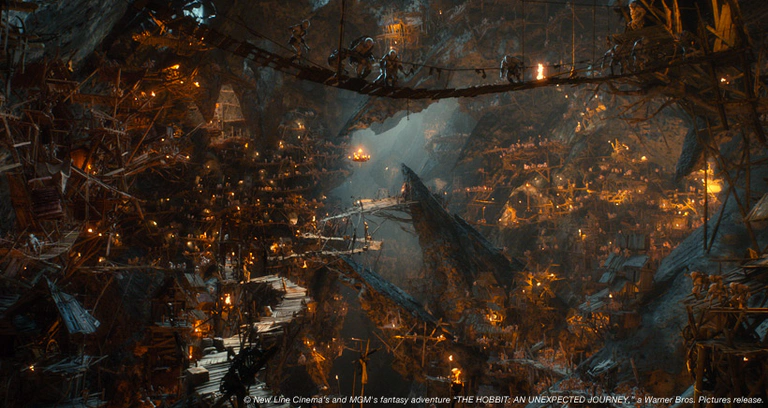
The Great Goblin was a very large creature with a huge head, ruling a group of Northern Orcs living in the caves of Goblin-town near the High Pass. They preyed on travelers who used another, easier pass near the main gate of Goblin-town, until such people began avoiding the route. The Orcs then made another gate opening into a cave they called the Front Porch, at the top of the High Pass. On occasion, the Great Goblin ordered his Orcs to catch fish for him in the dark lake near Goblin-town, below the Mountains, and these Orcs were sometimes killed by Gollum.

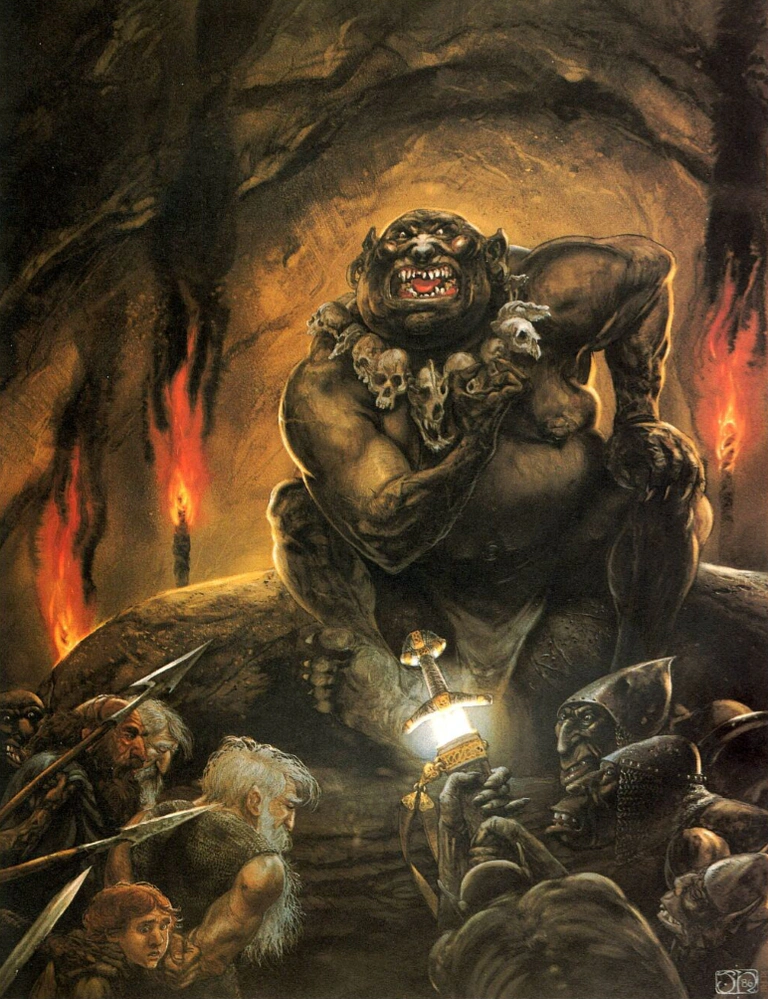
In the summer of TA 2941, the Dwarves of Thorin and Company, along with Bilbo Baggins, were captured on the Front Porch and were brought before the Great Goblin in his great hall, where he was seated on a flat stone and surrounded by armed guards. The Great Goblin demanded to know what the Dwarves were doing in the mountains.
When it was revealed that Thorin carried the Elvish sword Orcrist - which the Orcs feared and which they called "Biter" - the Great Goblin was enraged and at once leapt to attack Thorin. Immediately, all the torches in the cave were extinguished and a glowing sword "bright as blue flame" appeared. It was Glamdring, called "Beater" by the Orcs, and now wielded by Gandalf. As the Dwarves were escaping, the Great Goblin leapt down in front of them and attacked Gandalf who was at the head of the party. Gandalf then fought back, stabbing the great lord of the cave, killing him.
The death of the Great Goblin angered the Orcs of the Misty Mountains. A great army of Orcs and Wargs was amassed by Bolg, whose father Azog had been killed by the Dwarf Dáin II. Bolg's forces tracked Thorin and Company to the Lonely Mountain, where they fought in the Battle of Five Armies against the Dwarves, Elves, and Lake-men.
Rankin/Bass version
In the 1977 Rankin/Bass version of The Hobbit, the Great Goblin was voiced by John Stephenson.
The Hobbit film trilogy
Well, well, well! Look who it is; Thorin, son of Thráin, son of Thrór, "King under the Mountain". Oh, but I'm forgetting; you don't have a mountain, and you're not a king, which makes you... nobody, really.
Bones will be shattered, necks will be wrung! You'll be beaten and battered, from racks you'll be hung! You will die down here and never be found! Down in the deep of Goblin-Town!
In Peter Jackson's film The Hobbit: An Unexpected Journey (2012), Barry Humphries, who is more commonly known for his alter ego Dame Edna Everage, is the voice and motion-capture performer of the Great Goblin, an entirely computer-generated character. He appears as a giant, obese, bloated goblin (more akin to a troll) with lots of warts, lumps, and scars, and carries a large staff decorated with an animal skull, closely resembling a ram, adorned with shrunken heads.

His death is portrayed quite differently than in the book. He is knocked off a cliff by Thorin when Gandalf saves the company and is killed after the fight through Goblin-town when Gandalf slashes his abdomen and cuts his throat.
Voice dubbing actors
- Spanish (Latin America) Humberto Vélez - Spanish (Spain) Francesc Belda - Portuguese (Brazil) (Television/DVD) Sérgio Fortuna - German Hartmut Neugebauer - Italian (Italy) Massimiliano Plinio - French (France) Paul Borne - Czech Karel Gult - Slovak Ivan Laca - Polish Michał Piela - Hungarian Faragó András
Radio
• Denis McCarthy voiced the character in the 1968 BBC Radio radio adaptation of The Hobbit.
• Joe Hughes voiced the character in the 1979 The Mind's Eye radio adaptations of The Hobbit and The Lord of the Rings.
• Heinz Theo Branding voiced the character in the 1980 German radio serial adaptation of The Hobbit.
• Karol Čálik seems to have voiced the character in the 1989 Slovak two-episode radio miniseries adaptation of The Hobbit, though he is not directly credited.
Sources
Adapted from the original article, under CC BY-SA 3.0.