Group
Orcs
Primary soldiers of both Dark Lords' armies, and their most common servants
Tolkien creates them to represent all that is bad about modern war.
Orcs were the primary soldiers of both Dark Lords' armies, and their most common servants. Invented by Melkor during the latter Years of the Trees of the First Age, they served him and later his successor, Sauron, in their aims to dominate Middle-earth. It was believed by the Eldar that before Oromë first discovered Cuiviénen, Melkor had kidnapped some of them and cruelly deformed them, twisting them into the first Orcs.
After the Battle of the Powers, many Orcs alongside other servants of Melkor survived in the deep caves, pits, chambers, and tunnels of Melkor's underground fortress, Angband. They multiplied there and later spread through northern Middle-earth. They were first seen by the Dwarves who reported them to Thingol, King of Doriath, causing the latter to seek weapons of war for the first time. From that time forward, Orcs would be present in almost all scenes of war and strife in Beleriand, and in Middle-earth after the First Age until Mordor was destroyed.
Orcs referred to themselves in the Black Speech with the term Uruk, which generally referred to the strongest of their kind, such as the Uruk-hai and Uruks of Mordor.
First Age
It is not known with certainty how the Orcs came to be. Melkor was the first to learn of the Awakening of the Elves at Cuiviénen, and soon began sending evil spirits among them, who planted seeds of doubt against the Valar. It is rumoured that some of these Elves were being captured by a "Rider" if they strayed too far, and it was believed by the Eldar that these unfortunate Elves were brought to Utumno, where they were cruelly tortured and twisted into Orcs.

In the last six centuries of the First Age, thousands of Orcs were bred in Angband by Morgoth and to participate in the Battles of Beleriand, which began after the Ñoldor arrived to north-western Middle-earth. They first appeared in the Battle of the Lammoth, where they were defeated by the Elves. When the House of Fëanor returned to Middle-earth, Morgoth sent a force of Orcs against them. Although the Orcs outnumbered the exiles they were no match for the power and wrath of the Ñoldor, and were quickly and easily defeated. However, Fëanor could not defeat the power of Morgoth alone and he was killed by Balrogs, leaving the Orcs to continue to breed under the Dark Lord. Years later, when the House of Fingolfin arrived in Middle-earth, Orcs were sent against them as well, but they were utterly defeated in the Battle of the Lammoth.
After their crushing defeat in the Dagor Aglareb and in a minor raid on Hithlum, the Orcs nevertheless regained their numbers. In the Dagor Bragollach and Nírnaeth Arnoediad, they and their master won crushing victories against the free peoples. However, they were nearly destroyed in the War of Wrath that ended in FA 585, and those that survived fled eastwards into the Mountains of Angmar, Grey Mountains, or Red Mountains.
Second Age
Sometime around year 1000 of the Second Age, Sauron reappeared in Middle-earth, made the land of Mordor his realm, and then started to build the foundations of Barad-dûr. During the War of the Elves and Sauron in SA 1700, the Orcs formed the main host of Sauron's power. Despite the immeasurable number of Orcs present, the battle was won by the Elves and the Númenóreans due to their united force, superior weaponry, greater strength and stature and combat skill.
However, Sauron had not been able to gather all the Eastern Orcs into his armies, as they at first scorned him, seeing only his fair form. It was after his first defeat that Sauron went back among them, in a dark guise, and subdued them, and was able to begin rebuilding his power.
Until Sauron's final downfall in the Third Age, Orcs remained the backbone of the armies of Mordor, and of Isengard while the wizard Saruman ruled it.
Third Age
After the War of the Last Alliance, Mordor was desolate and the surviving Orcs were concentrated in the Misty Mountains. With the return of Sauron to Dol Guldur and the spread of his evil influence, their numbers began to increase once more. In TA 2475 at the ending of the Watchful Peace, a new tougher, stronger breed of Orc appeared; the Uruk-hai, specifically bred for fighting Men.
Following the abandonment of Khazad-dûm by the Dwarves, Orcs eventually colonized the abandoned halls, killing King Thrór when he sought to enter his lost realm. This triggered the War of the Dwarves and Orcs, a massive conflict where the Dwarves gathered their full strength and destroyed every Orc-hold they could find in the Misty Mountains. This and the Battle of Five Armies greatly reduced the numbers of Northern Orcs, weakening their contribution to the War of the Ring.

In the meantime Sauron had returned to Mordor, rebuilding his fortress and creating a vast army of Orcs. He bred a huge breed of Orcs-soldiers with great strength, the Uruk-hai, some time before TA 2475, when they creatures first appeared from Mordor ravaging Ithilien and Osgiliath. Later, some of these Orcs populated the Misty Mountains and subdued local Orkish tribes. Sauron's pawn, Saruman the Wizard, also bred those Uruk-hai, who descended from the Misty Mountains and served him as mercenaries; he also experimented on cross-breeding of Orcs and Men, producing Half-Orcs even taller than Uruk-hai.
Following the destruction of the One Ring, the Orcs scattered, eventually dwindling and being hunted largely to extinction in the Fourth Age.
Characteristics

For all that race were bred by Melkor of the subterranean heats and slime. Their hearts were of granite and their bodies deformed; foul their faces which smiled not, but their laugh that of the clash of metal, and to nothing were they more fain than to aid in the basest of the purposes of Melkor.
In J.R.R. Tolkien's writings, Orcs were cruel, sadistic, black-hearted, vicious, and hateful of most things, particularly of those who were orderly and prosperous. They were short in stature (unless of the Uruk-hai variety) and humanoid in shape. They were generally squat, broad, flat-nosed, sallow-skinned, bow-legged, with wide mouths and slant eyes, long arms, dark skin, and fangs (this description has become controversial, as Tolkien noted Orcs would appear to Europeans as "least-lovely Mongol types", and based the Uruk-hai on (what is now considered) a xenophobic depiction of the Huns from a Roman historian's perspective, so certain traits such as "slant-eyed" and having dark skin are more viewed today as racist depictions of Orcs characteristic to racial stereotypes of Tolkien's time). Tolkien describes one "huge Orc chieftain" as "almost Man-high", and some must have been close to Hobbit height, as Sam and Frodo were able to disguise themselves as Orcs in Mordor. They were roughly humanoid in shape with pointed ears, sharpened teeth and grimy skin. Their appearance was considered revolting by most of the other races. Most Orcs did not live long, as they were viewed as expendable by the Dark Lords; however, in peacetime, certain Orcs such as Azog and Bolg lived for well over a century, so it is likely they lived quite long when not being ruled by the Dark Lords.

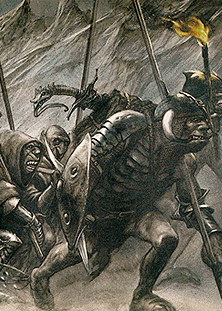
Orcs made no beautiful things, but many clever ones including machines, tools, weapons, and instruments of torture. They were delighted by wheels, engines, and explosions, and could tunnel and mine as well as any but the most skilled Dwarves, though they are often untidy and dirty. This was so since the time Melkor created them (by an unknown process). They hated themselves, and had an even deeper secret hatred for Melkor, thus resulting as a violent and warlike race in a perpetual state of chaos with itself and others. Despite their abominable nature, Orcs were often crafty and clever rather than dim-witted. Tolkien writes that they were capable smiths and craftsmen, though things of their making are described as crude compared to those of the Free Peoples. They seemed to favor scimitars, as opposed to straight swords. Orcs also developed tunnel-making, so as to dwell underground away from the light. It is also worth noting that Orcs prefer to do no more work than they can help, as they would rather coerce others into working for them.
Wickedness and violence were their nature, and it was not uncommon for them to kill each other in petty quarrels. They had a destructive effect on nature, especially forests, and often destroyed trees to fuel their war-making, particularly those near Isengard. Orcs had unchangeable disdain for all Elves, Dwarves, and Men, though they fought alongside wicked men under Morgoth and then Sauron in the First, Second, and Third Ages and were also said to have made alliances with wicked Dwarves.
Terminology
Orc is not an English word. It occurs in one or two places [in The Hobbit] but is usually translated goblin (or hobgoblin for the larger kinds).
Tolkien explained in a note at the start of The Hobbit that he was using English to represent the languages used by the characters, and that goblin (or hobgoblin for the larger kind) was the English translation he was using for the word Orc, the hobbits' form of the name. Tolkien used the term goblin extensively in The Hobbit, and also occasionally in The Lord of the Rings, as when the Uruk-hai of Isengard are first described: "four goblin-soldiers of greater stature".
A clear illustration that Tolkien considered Goblins and Orcs to be the same thing, the former word merely being the English translation of the latter is that in The Hobbit (the only one of Tolkien's works in which he usually refers to Orcs as goblins), Gandalf asks Thorin if he remembers Azog the Goblin who killed his grandfather Thrór, while in all his other writings Tolkien describes Azog as a "great Orc".
In The Hobbit, Tolkien mentions Orcs as a large variety of Goblins, leading some to the notion that the Northern Orcs of the Misty Mountains were of smaller build than average Orcs, although the "Great Goblin" and "Azog the Goblin" (as he was called in The Hobbit) were massive in size. Tolkien also described Goblins as big, ugly creatures, "cruel, wicked, and bad-hearted."
In other writings
Goblins appear in some of Tolkien's other writings outside of the legendarium. For example, in Letters from Father Christmas, they were enemies of and of Red Gnomes, Green Elves, and Snow Elves. In this account, Goblins used a pictographic writing system.
Sources
Adapted from the original article, under CC BY-SA 3.0.