Place
Barad-dûr
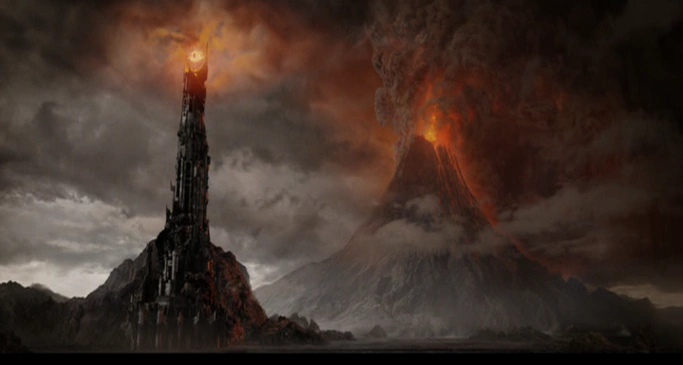
Barad-dûr ("Dark Fortress") was Sauron's central stronghold in Mordor, serving…
Then at last his gaze was held: wall upon wall, battlement upon battlement, black tower of adamant, he saw it: Barad-dûr, Fortress of Sauron. All hope left him.
Barad-dûr ("Dark Fortress") was Sauron's central stronghold in Mordor, serving as his seat of power in Middle-earth in the Second Age until its end and again in the late Third Age after its rebuilding. Its final destruction happened a few years before the end of the Third Age.
Barad-dûr was sustained by dark magic and was the greatest fortress in Middle-earth of its time. It was built in the Second Age, and leveled after Sauron's defeat in the War of the Last Alliance. Sauron rebuilt it late in the Third Age as he regained his power, but it was forever destroyed immediately upon the destruction of the One Ring.
In his writings, J.R.R. Tolkien describes little of the tower besides its terror, color, and surreal size.

History
Following Sauron's occupation of the land of Mordor in SA 1000, he began making plans for the construction of a vast and powerful fortress, to serve as his seat of power.
He established Barad-dûr. upon the Plateau of Gorgoroth near Mount Doom. Construction began around the SA 1000, and took six hundred years to complete. It was the greatest fortress built since the fall of Angband during the War of Wrath.
By the time of its completion the fortress surpassed the greatest strongholds of Men in both size and defences. Compared to the famed strongholds of Minas Arnor and Minas Ithil, Barad-dûr was practically impregnable. Aside from towering over both fortifications. Barad-dûr’s very foundations were imbibed with the darkest and most persistent of Saurons black magic.
The walls of Barad-dûr were constructed from stone hewn from Mount Doom and imbibed with powerful dark magic which increased their resistance to corrosion and breakage. Furthermore the fortress bristled with various defences of all kinds including, hundreds of trebuchet batteries, spiked parapets and a vast concentric lava moat several hundred feet wide and several hundred feet deep. Further complementing its fierce defences the fortress was capable of garrisoning tens of thousands of Orcs and other evil creatures within its expansive interior.
It was from Barad-dûr that Sauron held court, alongside his many thralls and underlings. The Nazgûl were known to frequent the dark fortress in order to receive new orders from their master. It is also speculated that Sauron was in possession of an extremely powerful Palantír which he kept housed within a hall deep within Barad-dûr.
Barad-dûr was besieged for seven years by the Last Alliance of Elves and Men during the Second Age, and was levelled after Sauron's defeat at the hands of Isildur during the Battle of Dagorlad. But because it was created using the power of the One Ring, its foundations could not be destroyed while the Ring itself still existed. As Isildur failed to destroy the Ring, the tower was eventually re-built when Sauron returned to Mordor thousands of years later in TA 2942.

Near the end of the Third Age (between TA 3009 and 3017), Gollum was captured by Orcs and taken to Barad-dûr, while Gandalf and Aragorn were also searching for him. He was brutally tortured for information regarding the whereabouts of the One Ring, as Sauron had learned that he had once possessed it, and thus Sauron learned that the One Ring had been found. Then, after a very long time, they managed to wring the words Shire and Baggins from Gollum. Satisfied that he had learned all he could from the creature, and hoping to learn more by tracking him, Sauron released Gollum in TA 3017.
Only when Frodo Baggins, with the unwitting aid of Gollum, destroyed the One Ring within Mount Doom, was Barad-dûr finally and permanently destroyed. Without Sauron's power from the Ring to sustain it, The fotress gave way and collapsed, never to be rebuilt.
The Return of the King animated film (1980)
In The Return of the King film created by Rankin/Bass, Barad-dûr is only shown a few times. It is depicted as a castle-like fortress on the side of a mountain. The Eye of Sauron is not a part of the tower; rather it appears in the skies of Mordor.

The Lord of the Rings film trilogy
For The Lord of the Rings film trilogy (2001 - 2003) directed by Peter Jackson, Richard Taylor and his design team built a 27-foot-tall "bigature" of Barad-dûr for use, at 1:66 scale, basing its appearance on an illustration by John Howe done originally for Tolkien Calendar 1991. Using the size scale for the model, the tower is shown to be around 5,000 feet tall, with the Eye of Sauron at its apex. Barad-dûr's entirety is seen in an upward-panning vision Frodo has in the first film, at Amon Hen.
In the final battle in The Lord of the Rings: The Return of the King, at the Black Gate, the Dark Tower is shown to be in much closer proximity than it would have been according to Tolkien's maps. The animation of the tower's climactic destruction, when the One Ring has been destroyed, was rendered by Gray Horsfield.

The Dark Tower is beyond architecture. As the physical envelope of Sauron in Middle-earth, it can obey laws beyond the strictly architectural. I see it very much as an extension of his soul. If [Sauron's] mind could take shape, then it would be a hideously tall tower such as this.
Middle-earth: Shadow of War
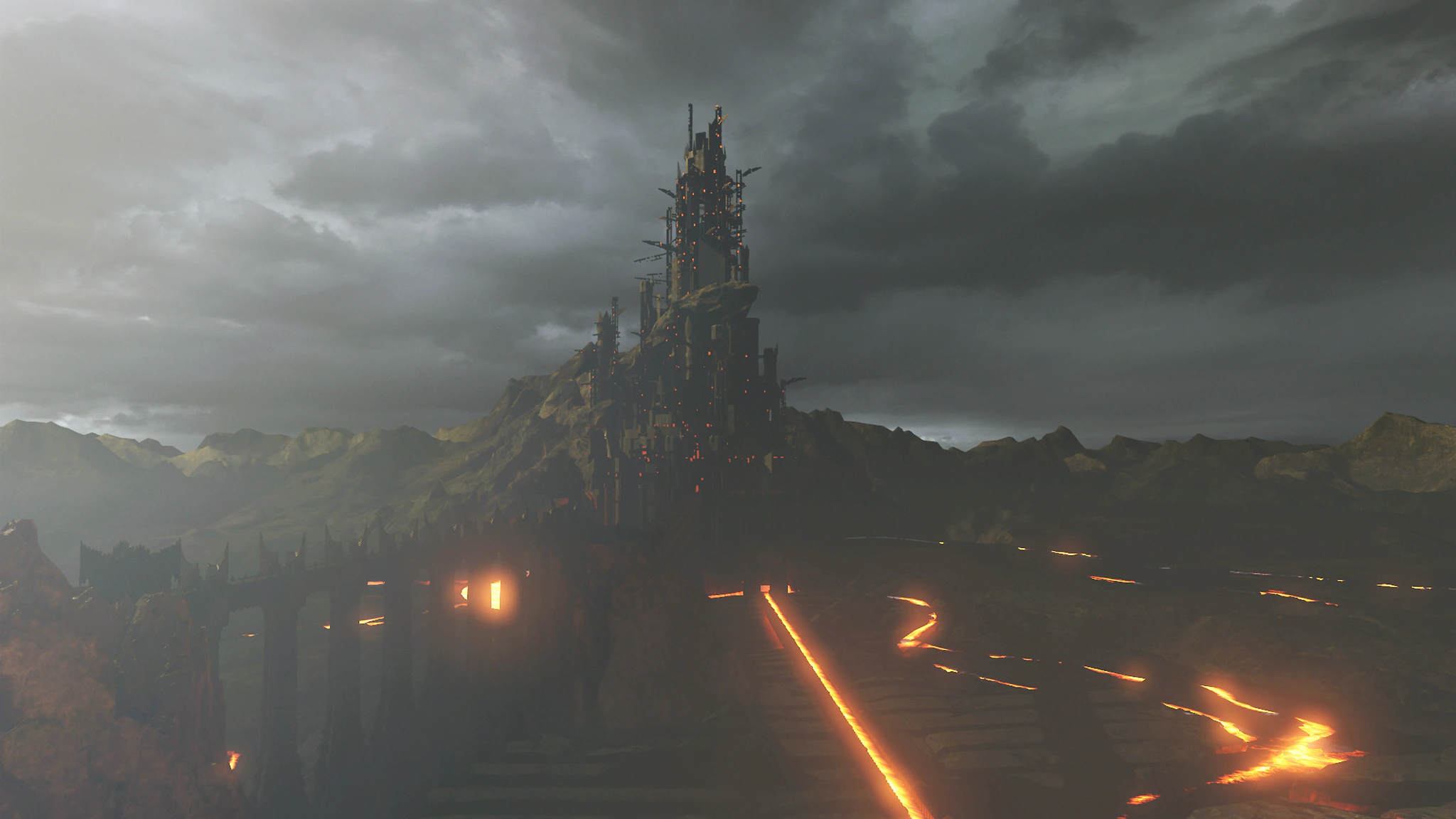
Barad-dûr is visible, though not a playable location, in the region of Gorgoroth in Middle-earth: Shadow of War. It is depicted similarly to its appearance in The Lord of Ring film trilogy. However, its appearance changes as the events of the game progress. Initially, its height is half that of Orodruin, and it's under heavy construction, and is very small on the map. During the middle of the game, it's much larger, but still uncompleted. After the game's over, it's at its true massive size, and complete with the Eye of Sauron at it's peak.

Sources
Adapted from the original article, under CC BY-SA 3.0.