Work
The Lord of the Rings: The Fellowship of the Ring
2001 fantasy adventure film, directed by Peter Jackson
The Lord of the Rings: The Fellowship of the Ring is a 2001 fantasy adventure film, directed by Peter Jackson. It is the first of The Lord of the Rings films, adapting the first part of the best-selling trilogy by J.R.R. Tolkien. The film tells the story of young hobbit Frodo Baggins who, accompanied by eight companions, embarks on a journey to destroy the One Ring in the fires of Mount Doom.
The screenplay was first started by Fran Walsh, Philippa Boyens, and Peter Jackson in 1997, and eventually it was reaching completion in tandem with its filming, on location in New Zealand. The film had a budget of about $180 million U.S. dollars, principal photography took 14 months, and post production continued long after that. It was also a great box office success, making over $868 million worldwide on its initial release and was the fifth highest-grossing film of all time at the time of its release (behind Titanic, Harry Potter and the Philosopher's Stone, Star Wars: Episode I – The Phantom Menace, and Jurassic Park). After the 2011 re-release of The Lion King and the 2012 re-release of Finding Nemo, it was the 68th highest-grossing film of all time.
The film was the first live-action film adaptation of Middle-earth to be released.
Synopsis
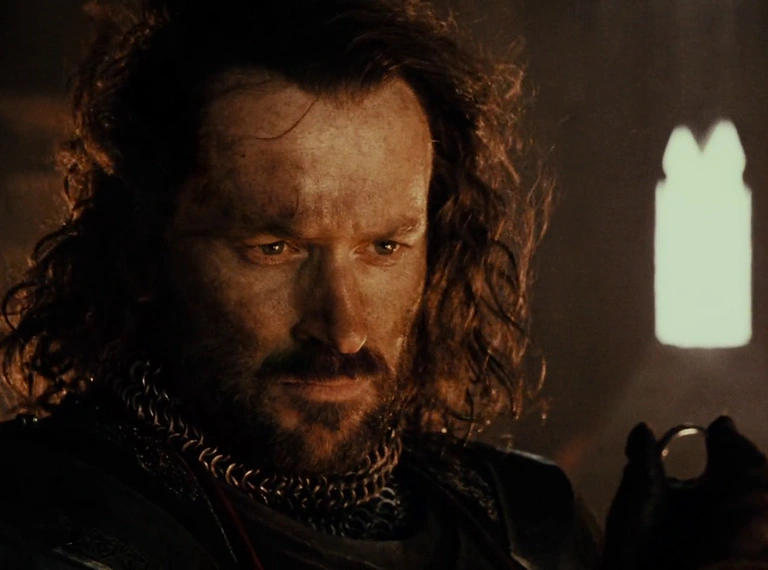
Sauron, the Dark Lord who has been defeated years ago during the War of the Last Alliance by Elendil, Isildur, and Elrond, has awakened and threatens to conquer Middle-earth. To stop this ancient evil once and for all, Frodo Baggins must destroy the One Ring in the fires of Mount Doom. Men (Aragorn and Boromir), Hobbits (Sam, Merry, and Pippin), a wizard (Gandalf), an Elf (Legolas), and a Dwarf (Gimli) form a fellowship to help him on his quest.
He travels from his home in The Shire with fellow hobbits Sam, Merry, and Pippin. They go to the town of Bree, where the group meets a shadowy figure known only as Strider. Pursued by Black Riders, they must get to Rivendell. Upon their arrival a council is convened, which decides the only course of action must be to take The Ring to Mordor and destroy it. Frodo is joined by his friends Sam, Merry, Pippin, Aragorn, and Gandalf; along with newcomers Gimli, Legolas, and Aragorn. They try to cross over the Misty Mountains by way of the Pass of Caradhras, but Saruman's magic forces them to turn back and travel underneath, through the mines of Moria. It is here that the Fellowship encounters a Balrog. Gandalf challenges the Balrog and falls from the Bridge of Khazad-dûm into a chasm, presumably to his death. The Fellowship (excluding Gandalf) then travel to the Elven realm of Lothlórien, and down the Great River on boats, where the company splits during an attack by Uruk-Hai. Boromir is killed, and Aragorn, Gimli, and Legolas split off to track the Uruk-hai who have captured Merry and Pippin. Frodo and Sam head east in the direction of Mordor.
Plot
Following his 111th birthday party, Bilbo Baggins gives the Ring to his nephew, Frodo. After some time, the wizard Gandalf the Grey begins to suspect Bilbo's magic ring may be The One Ring, lost for over three-thousand years, and rides to Minas Tirith for discernment and confirmation of this suspicion - he is taken to a small room filled with many books and historical documents. After poring over old documents for months, he finds the account of the finding of the One Ring. Gandalf learns that the Ring has several lines of Black Speech written on it that are only visible if the Ring is heated with fire. He returns to Bag End only to learn that the ring Frodo has been holding onto is, in fact, Sauron's One Ring. Gandalf tells Frodo to leave the Shire immediately with the Ring. Gandalf catches Samwise Gamgee eavesdropping by a window and decides to send him along with Frodo. Gandalf rides to Isengard to meet with Saruman the White who reveals to Gandalf that the Nazgûl, or Ringwraiths, have left Minas Morgul to capture the Ring and kill whoever carries it. Gandalf attempts to flee to warn Frodo, but Saruman, having already been corrupted to Sauron's cause, shuts the doors and attempts to sway Gandalf into joining him and Sauron. Angered at Saruman's betrayal, Gandalf refuses, which leads to a fight between the two. Saruman defeats Gandalf and imprisons him atop his tower Orthanc. Gandalf is then forced to watch as Saruman, following Sauron's orders, commands the Orcs of Isengard to construct weapons of war and produce a new breed of Orc fighters called the Uruk-Hai.
Setting out to Rivendell
While traveling to the town of Bree, Frodo and Sam are soon joined by fellow hobbits, Merry and Pippin. After encountering a Ringwraith on the road, they manage to reach Bree only to discover that Gandalf hasn't arrived yet. Instead, Frodo meets a man called "Strider", who agrees to lead them to Rivendell. They continue traveling and spend the night on the hill of Weathertop, where they are attacked by the Nazgûl. Strider fights off the Ringwraiths, but Frodo is grievously wounded by one of the wraiths that stabbed him with a Morgul blade, which will cause him to turn into a wraith if not attended to with the proper care. While chased by the Nazgûl, Frodo is taken by the Elf Arwen to the Elven haven of Rivendell, and healed by her father, Elrond (the leader of the Elves at the battle of Mount Doom three-thousand years before). Arwen also uses her magic to cut off the pursuing Ringwraiths at the Ford of Bruinen, summoning a surge of water that sweeps the Ringwraiths away.

In Rivendell, Frodo finds Gandalf, who explains why he didn't meet them at Bree and that he had escaped Orthanc and Saruman's betrayal and clutches with the help of an eagle. Later, Elrond calls a council to decide what should be done with the Ring. Elrond warns against keeping the Ring in Rivendell for long, knowing that the Elven realm could come under attack from both Mordor and Isengard. The Ring can only be destroyed by throwing it into the fires of Mount Doom, where it was forged. Frodo volunteers to take the Ring to Mount Doom and is accompanied by his hobbit friends and Gandalf, as well as Strider, who is revealed to be Aragorn, the rightful heir to the throne of Gondor. Also travelling with them are the Elf Legolas, the Dwarf Gimli, and Boromir, the son of the Steward of Gondor. Together they comprise and become the Fellowship of the Ring.
Gandalf faces against the Balrog
"I am the servant of the Secret Fire, wielder of the Flame of Anor. The dark fire will not avail you, flame of Udun! (Balrog slams the shield with a sword and vanquishes it) Grr! Go back to the shadow! YOU, SHALL NOT PASS!" - Gandalf's most iconic quote

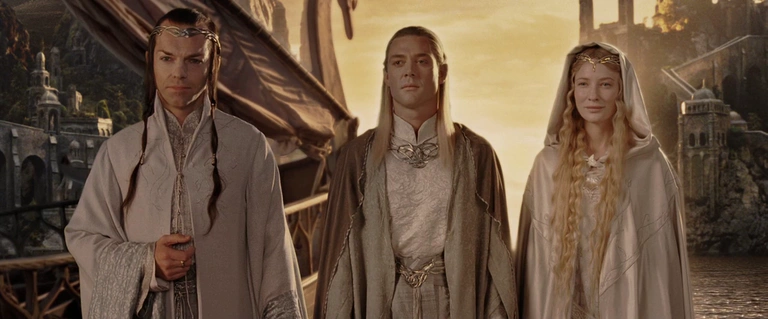
The Fellowship sets out and tries to pass over the Misty Mountains by the mountain pass of Caradhras. Saruman creates an enormous storm, triggering avalanches and heavy snowfall, which nearly wipes out the Fellowship. At Gimli's insistence, they decide to seek safety and travel under the mountain through The Mines of Moria. Frodo agrees, but while travelling they are attacked by the Watcher in the Water, forcing them to travel through the mines. Inside, they encounter Goblins and a cave troll in the Chamber of Mazarbul, and encounter a Balrog, an ancient demon of fire and shadow, at the Bridge of Khazad-dûm. Gandalf faces the Balrog on the bridge and manages to send it plunging into the abyss below, but the monster drags him down with it. The group escapes the underground realm and flees into the Elven realm of Lothlórien, where they are sheltered by its rulers, Galadriel and her husband Celeborn. That night, Frodo meets Galadriel, who tells him that it is his destiny to handle the Ring and ultimately destroy it. Before they leave, Galadriel gives Frodo the Phial of Galadriel, and the other members also receive gifts from them. Taking the straight path to Mordor, they travel on the River Anduin towards Parth Galen.
The splitting of the Fellowship
After landing at Parth Galen, Boromir tries to take the Ring from Frodo, believing it to be the only way to save his realm, but Frodo escapes him, and Boromir is overcome with shame at what he had done. Aragorn encounters Frodo, but unlike Boromir, Aragorn manages to resist the Ring's temptation and chooses not to take it. Knowing that the Ring's temptation will be too strong for him or anyone else that is in the fellowship, Frodo decides to leave them and go to Mordor alone. Meanwhile, the rest of the Fellowship are attacked by Uruk-Hai, who Saruman had ordered to hunt down the Fellowship and take the Ring. Aragorn and the fellowship distract the Uruk-hai so that Frodo can escape; Merry and Pippin, also realizing that Frodo is leaving, distract the orcs, allowing Frodo to escape.

As Boromir rushes to the aid of the two hobbits, he is mortally wounded by the Uruk commander Lurtz. Before Lurtz can finish off Boromir, Aragorn arrives and attacks Lurtz, decapitating him after a short but brutal fight. As he lies dying, Boromir regrets having attempted to steal the Ring and is forgiven by Aragorn. Merry and Pippin are then captured, prompting Aragorn, Gimli, and Legolas to begin their pursuit of the orcs with the intent of rescuing the hobbits - leaving Frodo to continue his quest. Frodo returns to the banks of the river and begins rowing across when Sam appears and swims out after him, insisting he has promised Gandalf he would look after Frodo. Frodo accepts Sam's presence and together they continue their journey to Mordor through the hills of Emyn Muil.
Cast
(as given in the end credits)
- bgcolor="#ccc" - Voice of the Ring - Everard Proudfoot - Sam - Sauron - Boromir - Galadriel - Legolas - Pippin - Otho - Celeborn - Mrs. Bracegirdle - Mrs. Proudfoot - Gondorian Archivist - Gil-galad - Extended Edition only) - Bilbo - Old Noakes (Extended Edition only) - Gandalf - Saruman - Lurtz - Witch-king - Elendil - Rosie Cotton - Merry - Lobelia - Aragorn - Bounder - Haldir - Farmer Maggot - Gimli - Gate Keeper - Ted Sandyman (Extended Edition only) - Gollum (voice) - Isildur - Arwen - Barliman Butterbur - Elrond Isildur (voice) - Frodo - Ringwraiths - Cute Hobbit Children
Uncredited
(as given on IMDB)
- bgcolor="#ccc" - Dwarf-lords - Hobbits - Orcs - Goblins - Uruk-hai - Council Elves - Last Alliance Elves - Lothlórien Elves - Uruk at Amen Hen - Rivendell Elves - Ringwraiths - Cute Hobbit Children - Gondorian Soldiers - Party Hobbits - Cave Troll - Birthing Uruk - Círdan the Shipwright - Isengard Orc Blacksmiths - Kissing Hobbit (Extended Edition) - Council Men - Kings of Men - Albert Dreary - Gondorian Citizen - Arms of Gollum - Female Hobbit - Figwit - Gondorian Guard - Hobbit Band Member - Burning Ringwraiths - Archers - Galadriel's Elf - Witch-king - Hand of Gollum - Breelanders - Refugee - Orc - Soldier - Morgul Orc - Wildman - Galdor - Elf - Witch-king (voices) - Screaming Ringwraith (voice) - Farmer Maggot (voice) - Extras
Special effects
The Fellowship of the Ring makes extensive use of digital, practical and makeup special effects throughout, as well as computer effects harnessed by Wētā Workshop's sibling group Weta Digital, which Jackson helped found. Many documentaries found in "Part Two" From Vision to Reality" (the fourth disc of the Extended Edition release) cover this area of the production process.
Personnel who worked on the special effects included Andrew Lesnie, Stephen Regelous, Paul Lasaine, Jeremy Bennett, Jon Labrie, Alex Funke, Brian Van't Hul, Gray Horsfield, Mark O. Forker of Digital Domain, and overall creative supervisor Richard Taylor.
One noticeable effect appearing in most scenes involves setting a proper scale so that the characters are all the proper height. Elijah Wood, who plays Frodo, is 5 ft 6 in (1.68 m) tall in real life; but the character of Frodo Baggins is barely four feet tall. Many different tricks were used to cast the hobbits and Gimli as diminutive. Large and small stunt doubles were used in certain scenes, while entire duplicates of certain sets (especially Bag End in Hobbiton) were built at two different scales, so that the characters would appear to be the appropriate size. At one point in the film Frodo runs along a corridor in Bag End, followed by Gandalf. Elijah Wood and Ian McKellen were filmed in separate versions of the same corridor, built at two different scales, and a fast camera pan conceals the edit between the two. Forced perspective was also employed so that it would look as though the short hobbits were interacting with taller Men and Elves. Kneeling was used to great effect for size compensation, to the surprise of many, as were over-sized body costumes (called "Big Rigs") and midget actors wearing masks of the Hobbits' faces.
For the battle between the Last Alliance and the forces of Sauron that begins the film, an elaborate CGI animation system, called Massive, was developed that would allow thousands of individual animated "characters" in the program to act independently. This helped give the illusion of realism to the battle sequences.
Conceptualization of fictional locations such as Khazad-dûm, the Argonath, Rivendell, and Isengard involved the use of many miniature sets and also "Bigatures", closer to life-size.
Filming locations
A list of filming locations, sorted by appearance order in the movie:

- bgcolor="#ccc" Fictional Location Specific Location in New Zealand General Area in New Zealand - Hobbiton Matamata Waikato - Gardens of Isengard Harcourt Park Upper Hutt - Shire woods Otaki Gorge Road - Bucklebury Ferry Keeling Farm Manakau - Forest near Bree Takaka Hill Nelson - Trollshaws Waitarere Forest - Ford of Bruinen Arrowtown Recreational Reserve Queenstown - Rivendell Kaitoke Regional Park Upper Hutt - Eregion Mount Olympus Nelson - Azanulbizar Lake Alta The Remarkables - Azanulbizar Mount Owen Nelson - Lothlórien Lake Wakatipu Queenstown - River Anduin Rangitikei River - River Anduin Poets' Corner Upper Hutt - Parth Galen Paradise Glenorchy - Amon Hen Mavora Lakes Milford Sound
Deviations from the source material
A small but vocal minority of admirers of the original book raised some concerns when the film was released, complaining that the movie's screenplay made a number of changes to Tolkien's story. Many of these protests seemed to be rather minor concerns and were largely ignored by general movie going audiences. However, more than a few people expressed surprise when the movie's plot diverged from that of the book in what might be considered more fundamental ways.
Other fans explain that, compared to the many film adaptations of literary works over the years, many of which bear little or no resemblance to the source material, this film and the remainder of the trilogy are still very faithful adaptations, with some changes necessary due to the differing limitations of film and decisions to emphasize certain themes visually for concepts communicated differently in the written version.
Bilbo's birthday party was actually a combined birthday party for himself and Frodo (who was 33) since they share the same birthday. The (controversial) number of guests invited to the party (144) was determined by adding their ages together.
Unlike in the book, though only the aftermath that was shown, Gandalf frantically ransacked Bag End just to be certain whether Frodo hid Bilbo's ring as instructed, which turned out to be unnecessary since Frodo did exactly as he told to long ago. He also put the Ring in a fire to see if it would reveal something confirming its true nature as the One Ring. This was likely done to hammer home the urgency surrounding the Ring, more so upon realization that he and Bilbo entrusted Frodo something which far more dangerous than they thought.
The Hobbits' adventures on the way from the Shire to Bree, which occupy over five chapters of the novel, were drastically cut, implying that the journey took place over a much shorter period of time. This material includes the Hobbits' interaction with Tom Bombadil, who is completely absent from the film, along with Goldberry. The time the Hobbits spend in Bree itself is also significantly shortened, and their acquisition of the pony, Bill, is missing (although he appears later in the first film). Also missing is an entire subplot in which Frodo pretends to be moving back to his ancestral home in Buckland, with the help of his Hobbit friends (who, in the book, turn out to be Sam's co-conspirators and are introduced quite differently).
The character of Saruman has a significant presence within the film. In the novel, Saruman was only mentioned by Gandalf at the Council of Elrond, but in the film his encounter with Gandalf is shown in full. The book does not explain how Gandalf was held captive, but the film shows Gandalf and Saruman engage in a rather violent wizard duel which results in Gandalf's capture. Saruman is also credited with influencing the storm on Caradhras, which in the film is more dangerous and almost results in the Fellowship's death. Saruman was also shown producing Uruk-Hai on the grounds of Isengard.
The character Radagast is absent, meaning that Gwaihir is summoned to Isengard by a different means; Gandalf communicates with a small moth which alerts Gwaihir.
Old Man Willow was transplanted to Fangorn Forest (in the extended version of The Two Towers).
At The Prancing Pony, when Pippin exposes them, Frodo does not entertain the room or sing his song, but tries to reach Pippin, which still results in his fall and "disappearing act".
Arwen Evenstar has a far greater role; her replacement of the character of Glorfindel from the novel raised the ire of many dedicated Tolkien fans. Additionally, she is shown to have great power when she causes the River Bruinen to flood and wash away the Ringwraiths. In the book, this was the work of Elrond and Gandalf.
On related note, due to the wound from the Morgul Blade's worsening effects where it threatened to turn him into a wraith, Frodo perceived Arwen as an angelic being emerging from heavenly light behind her alongside Asfaloth. The similar light also surrounded Frodo as Arwen carried him toward Elrond who immediately began the procedure to save the Hobbit.
This would be first of recurring instances of Elves in The Lord of the Rings and The Hobbit films to be portrayed as angelic despite mostly faithful to how they depicted in source materials. However, since Frodo could have some ability to perceive the Unseen, he could have been explained to be seeing aspects of the Elves in that realm. A counter argument to the aspect of the Unseen was that the shining light would have been more expected of one of the Calaquendi, which Arwen was technically not.
The Council of Elrond is trimmed to focus only the matter of the Ring, rather than any of the history surrounding it. Gimili also tries to destroy the ring with his axe, but fails, with the Ring shattering his axe's blade. Glóin appears, but has no speaking lines.
In the film, Sam is treated as an adult at Bilbo Baggins' farewell party; in the books, he was only 21 (still 12 years from his coming of age). Perhaps more significantly, Frodo appears much younger. The seventeen year time period between the party and Gandalf's return to the Shire is significantly shortened. This tightening of the timespan occurs frequently.
The characterization of Boromir is expanded somewhat, and his final stand at Amon Hen is included on-screen (an event which takes place in the next volume of the books). This change has been received fairly positively. Additionally, it's the Uruk-Hai who attack instead of Orcs, and the Uruk who kills him is a character created for the purpose of the film, named Lurtz in the script.
On related note, to emphasize emphasize One Ring's dangerous ability to tempt people, Boromir's lust for the ring was made more evident in the film, to the point where certain characters openly speak of his treachery. Galadriel directly warns Frodo that Boromir will attempt to take the ring from him. In the Extended Edition, Gandalf also warns Frodo.
Frodo informs Aragorn of his departure from the Fellowship. Also, he leaves in his boat in plain sight (unlike the book, where tried to leave while wearing the Ring).
To better convey how Sauron's presence could be felt as much as in the books, his Eye form made recurring appearance in visions experienced by Gandalf and Frodo (the former had it when touching Bilbo's ring which he later confirmed as One Ring as well as when covering the Palantír in Isengard, whereas Frodo when unwittingly wearing One Ring at the Prancing Pony and Gimli's ill-fated attempt in destroying it). In Frodo's case, it could also be attributed to the ability to perceive the Unseen as with perceiving Arwen as an angelic being as stated previously.
Linguistic elements
Some fans also felt that movie producers missed the linguistic basis of the work (as Tolkien invented the world to bring his languages alive and not the other way around):
In particular, Namárië, Galadriel's lament in Lothlórien that begins "Ai! laurië lantar lassi súrinen", did not appear in the film, although Tolkien considered it one of the highest points of The Fellowship of the Ring. A few lines of the poem do, however, make it into the soundtrack at the departure from Lórien. Other samples of Elvish language from the books are treated similarly. However, Elvish (most often Sindarin) is spoken extensively in the film, with and without subtitles. The Elvish lines were, for the most part, devised specifically for the film version, sometimes based on English text written by Tolkien.
The movie features numerous books and artifacts with Tengwar inscriptions. Even though they were researched for accuracy, they still show a couple of peculiarities and inconsistencies not found in Tolkien's own Tengwar samples.
Another idiosyncrasy of the films is that Hobbit writing is shown in the Latin alphabet, while the books state that the Hobbits used the Tengwar. However, the Latin calligraphy is written in such a way that it bears resemblance to the Tengwar, including tehtar above their corresponding vowels. This refers visually to the Tengwar while allowing the audience to immediately recognise the text.
Time Allotment
One can perform a comparative analysis of the film and the book by comparing scenes to chapters and comparing time to pages. Those chapters that have low pages per minute values are chapters that have been given focus in the movie, and the converse is true as well.
Section Pages Minutes pages/minute - Book One 180pp 64:10 2.8ppm - Chapter I - A Long-expected Party 22pp 19:30 1.1ppm - Chapter II - The Shadow of the Past 23pp 9:40 2.4ppm - Chapter III - Three is Company 21pp ~4:20 ~4.8ppm - Chapter IV - A Short Cut to Mushrooms 13pp ~4:20 ~3.0ppm - Chapter V - A Conspiracy Unmasked 12pp ~4:20 ~2.8ppm - Chapter VI - The Old Forest 14pp 0:00 ∞ - Chapter VII - In the House of Tom Bombadil 12pp 0:00 ∞ - Chapter VIII - Fog on the Barrow-downs 15pp 0:00 ∞ - Chapter IX - At the Sign of the Prancing Pony 14pp 5:30 2.5ppm - Chapter X - Strider 13pp 0:30 26.0ppm - Chapter XI - A Knife in the Dark 21pp 10:00 2.1ppm - Chapter XII - Flight to the Ford 18pp 6:00 3.0ppm - Book Two 180pp 95:10 1.9ppm - Chapter I - Many Meetings 21pp 12:50 1.6ppm - Chapter II - The Council of Elrond 33pp 6:50 4.8ppm - Chapter II - The Ring Goes South 23pp 9:40 2.4ppm - Chapter IV - A Journey in the Dark 27pp 10:00 2.7ppm - Chapter V - The Bridge of Khazad-dûm 12pp 17:40 0.7ppm - Chapter VI - Lothlorien 21pp 2:30 8.4ppm - Chapter VII - The Mirror of Galadriel 15pp 10:10 1.5ppm - Chapter VIII - Farewell to Lórien 13pp 0:50 15.6ppm - Chapter IX - The Great River 15pp 3:10 4.7ppm - Chapter X - The Breaking of the Fellowship 12pp 21:30 0.6ppm - Extras In Movie 0pp 4:00 0.0ppm - Total 375pp 170:00 2.2ppm
Awards
In 2002 the movie won four Academy Awards out of thirteen nominations. The winning categories were for
The other nominated categories were:
After the close of its theater run, it ranked in the top ten highest-grossing movies worldwide, with takings of $860,700,000 USA dollars from world-wide theatrical box office receipts (movie ticket sales). (Source: IMDB Top Movies Chart).
It has been voted Best Fantasy Film On Earth by movie fans.
The movie has also been released on videotape and DVD, with some editions having additional footage and commentary not included in the theatrical release edition. Notable among the restored scenes is additional footage of a smiling Galadriel bestowing gifts on the members of the fellowship. In the theatrical version, she appeared dark and brooding. On Tuesday, November 12, 2002, Special Extended DVD Edition of Lord of the Rings: The Fellowship of the Ring was released, containing 208 minutes (3 hours, 28 minutes) of footage.
On June 14, 2011, the digitally remastered version of Extended Edition of the film was re-released in theaters.
The extended editions of The Fellowship of the Ring and the second movie, The Lord of the Rings: The Two Towers had limited theatrical runs in selected cities worldwide in late 2003, during the run-up to the release of the final film, The Lord of the Rings: The Return of the King.
Followed by:
Previous version:
Best Cinematography,
Best Effects, Visual Effects,
Best Makeup, and
Best Music, Original Score.
Best Actor in a Supporting Role (Ian McKellen),
Best Art Direction-Set Decoration,
Best Costume Design,
Best Director,
Best Editing,
Best Music, Song (Enya, Nicky Ryan and Roma Ryan for "May It Be"),
Best Picture,
Best Sound, and
Best Writing, Screenplay Based on Material Previously Produced or Published.
The Lord of the Rings: The Two Towers, released in 2002.
The Lord of the Rings: The Return of the King, released in 2003.
The Lord of the Rings, a 1978 animated film by Ralph Bakshi.
Box office records
The film grossed approximately $871.5 million in box office (not including DVD and VHS sales), at an unadjusted-for-inflation rate. Adjusted for inflation, the total box office for this film is $1,075,835,513.
The Fellowship of the Ring was the lowest-grossing film of The Lord of the Rings film trilogy.
It was the second highest-grossing movie of 2001 behind Harry Potter and the Philosopher's Stone, making it the only film of the trilogy not to be the highest-grossing movie of the year it was released.
Errors
• During the opening prologue, the map of Middle-earth displayed on-screen shows the continent as it was at the end of the Third Age, when in fact the prologue is set during the Second Age (notable differences being that the Shire and Rohan wouldn't have existed at the time).
Sources
Adapted from the original article, under CC BY-SA 3.0.