Lore
Black Speech
Official language of Mordor
The Black Speech, also known as the Dark Tongue of Mordor, was the official language of Mordor.

History
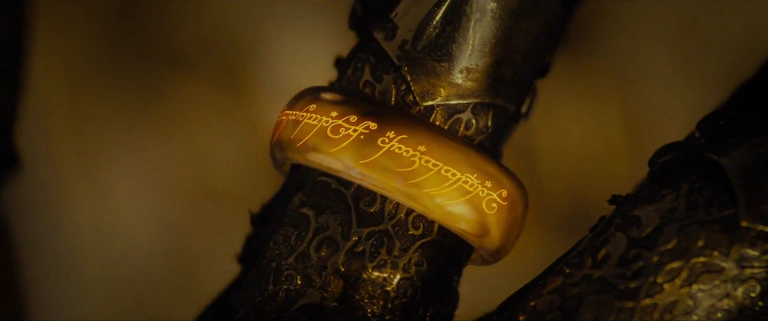
It is said that Sauron created the Black Speech to be the unifying language of all the servants of Mordor, used along with different varieties of Orkish and other languages used by his servants. J.R.R. Tolkien describes the language as existing in two forms, the ancient "pure" forms used by Sauron himself, the Nazgûl, and the Olog-hai, and the more "debased" form used by the soldiery of the Barad-dûr at the end of the Third Age. The only example given of "pure" Black Speech is the inscription upon the One Ring:
Ash nazg durbatulûk, ash nazg gimbatul, ash nazg thrakatulûk, agh burzum-ishi krimpatul.
When translated into English, these words form the lines:

One Ring to rule them all, One Ring to find them, One Ring to bring them all and in the darkness bind them.
These are the first two lines from the end of a verse about the Rings of Power.
Many Orkish dialects had adopted words from the Black Speech. One Orc from the band that took Merry and Pippin prisoners utters a tirade of curses at one point that is presumably Orkish, but apparently contains at least some elements of Black Speech. Chiefly, the Orcs in general could speak Common Speech, but many Mordor-Orcs, and Northern Orcs and Orc-kind in general, used the Black Speech as their language (though it was more a mix of Black Speech and Orkish).
Black Speech could be understood by anyone who wore the One Ring. Samwise Gamgee wore the ring in the Tower of Cirith Ungol to be invisible from Orcs of Sauron, and in the process heard many of the Orcs' plans.
Speaking the pure Black Speech had a harshening effect on the speaker's voice and a darkening effect on the speaker's surroundings, as seen when Gandalf recited the Ring Poem at the Council of Elrond. This effect did not extend to Black Speech loanwords in other languages, such as the word "Nazgûl".
Background
In real life, J.R.R. Tolkien created this language with the intention of making it harsh and ugly. The Black Speech is unfortunately one of the more incomplete languages in Tolkien's novels, as the forces of good are reluctant to utter it. Unlike Elvish languages, there are no poems or songs appear written in it (apart from the Ring's inscription), and because Tolkien designed it to be unpleasant in his own mind, he did not enjoy writing in it; according to Tolkien, he once received a goblet from a fan with the Ring inscription on it in Black Speech, and Tolkien, finding it distasteful, never drank from it and used it only as an ashtray. The result is a random collection of words that are hard to actually use in day-to-day conversation. We learn from the text in the ring and its translation that the Black Speech is a strongly agglutinating language.
Russian historian Alexander Nemirovski identified an ergative case in durbatuluk and thrakatuluk according to a common suffix -tuluk meaning "them all", relating to the verb's object rather than to its subject. This was found as a similarity to other ergative languages such the of ancient Mesopotamia.
The Black Speech of Mordor is similar to Enochian, formulated by Elizabethan occultist John Dee which was demonized as language of Satan.
Words & fan expansion
Some of these words are presumed true to J.R.R. Tolkien's books; most others are part of the Neo-Black Speech lexicon invented in the making of Peter Jackson's The Lord of the Rings film trilogy and The Hobbit film trilogy, or similar additions from The Lord of the Rings: The Rings of Power series, and some are from fans (with various reasoning or not).
-a - to (Debased Black Speech)
alba - elf
Kishdibadoth - search it
Hash bulzu (sounds) - It is time
Trugiyok Ista= March with me
Ist - My
Zum - Children
Bagronkat - suffering
Nampat - death
agh - and (for conjoining sentences)
ash - one
burz - dark
burzum - darkness
durb - rule
carnish - ambush
gazat - dwarf
ghâsh - fire
gimb - find
glob - filth
gûl - wraith
hai - folk
-ishi - in
krimp - bind
Kipak= told
Shupák= loved (or love? Is used in the context of love)
lug - tower
mas - mine
nazg - ring
nugu - nine
olog - troll
ombi - seven
ronk - pit/pool (bagronk, as muttered by an Orc in The Two Towers, means "dung-pit")
sha - and (for binding nouns)
shara - man
sharkû - old/old man (Debased Black Speech)
shre - three
snaga- slave
thrak - bring
-tul - -them
ûk - all
-um - -ness
uruk - orc
zagh - mountain pass/mountains
Hai Uk Zambat - All hail
Neo-Black Speech
"Neo-Black Speech" is the conventional name of various attempts of expand Black Speech, all non-canonical.
Because Tolkien intended Black Speech to sound unpleasant and harsh, he did not enjoy writing in it, and for this reason he likely created very little vocabulary. Thus, for Peter Jackson's The Lord of the Rings film trilogy, linguist David Salo expanded on what words were known, to provide words in new phrases, used primarily in the soundtrack. Salo's additions were the first major expansion to be called "Neo-Black Speech". In The Hobbit film trilogy, at one point in The Hobbit: The Desolation of Smaug, Azog speaks to the Necromancer in the Black Speech.
Some Orcs in certain adaptations know nothing of Black Speech, such as Ratbag in Middle-earth: Shadow of War (2017), who cannot understand the Neo-Black Speech of one of his Olog-hai friends.
One substantial Neo-Black Speech lexicon, called Shadowlandian Black Speech, was invented by fans sometime before 2014 at the website Mordor ~ The Land of Shadow.
Sources
Adapted from the original article, under CC BY-SA 3.0.