Place
Mount Doom
Mount Doom, also known as Orodruin and Amon Amarth, was a volcano in Mordor…
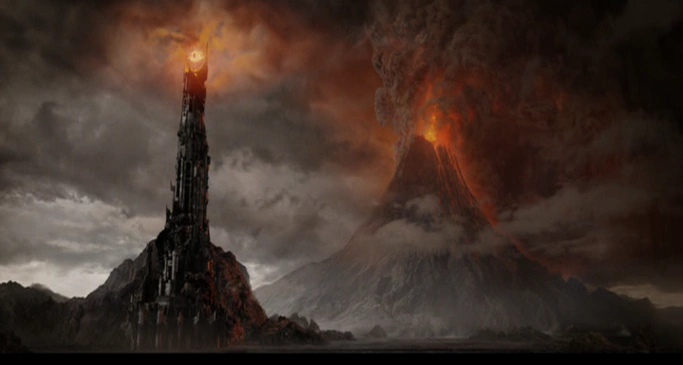
Mount Doom, also known as Orodruin and Amon Amarth, was a volcano in Mordor where the One Ring was forged by the Dark Lord Sauron, and accordingly the only place in which it could be destroyed. It was the ultimate destination of Frodo Baggins and Samwise Gamgee in the Quest of the Ring at the end of the Third Age.
History
Mount Doom was the result of works of the first Dark Lord, Melkor, in the First Age.
In the Second Age, Sauron chose the land of Mordor as his dwelling-place. He used the fire that welled there from the heart of the earth in his sorceries and his forging. Around SA 1600, Sauron forged the One Ring in the depths of the Cracks of Doom, which was built within Mount Doom itself. In SA 3429, Mount Doom erupted, signaling Sauron's attack on Gondor, where it earned its name "Amon Amarth."

After the War of the Last Alliance and Sauron's disappearance, the mountain slept, and only sprung into life in TA 2954, after Sauron's return to Mordor.
On March 25, TA 3019, Frodo and Sam ascended the slopes of Mount Doom, and entered Sammath Naur. Gollum had ascended as well, at a distance from them.
With the ensuing destruction of the One Ring, Mount Doom erupted with great force, sending massive lava floes down its sides and scattering the area with volcanic debris. The cone of the volcano was ripped apart by the eruption, and the Nazgûl and their mounts were destroyed in the ejection of lava as they tried to reach Frodo to reclaim the Ring.
Description
Mount Doom was located on the Plateau of Gorgoroth in northwestern Mordor. It stood about 4,500 feet with its base about 3,000 feet tall. It was connected to Barad-dûr through the steaming fissures of Sauron's Road.

In The Atlas of Middle-earth by Karen Wynn Fonstad, who published her work before the completion of The History of Middle-earth, it is suggested that the Mount Doom and all of Mordor formed as a result of a, draining the Sea of Helcar in the Belegaer, caused by the cataclysms of the War of Wrath. However, this hypothesis is negated in the 12th volume of The History of Middle-earth, The Peoples of Middle-earth, where is stated that the mountain had already been created by Melkor in the First Age.
In Rankin/Bass' The Return of the King
In The Return of the King film created by Rankin/Bass, Mount Doom is depicted as a slender composite volcano. The slopes of Mount Doom have a jagged, rocky landscape with ash channels. The Sammath Naur is shown as a small iron door way into a tunnel that leads to a open cavern with a lava pit in the center of it.
In Peter Jackson's The Lord of the Rings film trilogy
In Peter Jackson's film trilogy, the New Zealand volcano Mount Ngauruhoe was used as Mount Doom in some scenes. In long shots, the mountain is either a large model or a CGI effect or a combination. Filming the summit of Ngauruhoe itself was not permitted because it is sacred to the Māori of the region. However, some scenes on the slopes of Mount Doom were filmed on the actual slopes of Mount Ruapehu.
On November 22, 2012, it was incorrectly reported by media outside New Zealand that "Mount Doom" Ngauruhoe had erupted. The reported eruption was actually from nearby Mount Tongariro, not Mount Ngauruhoe.

In The Lord of the Rings: The Rings of Power
In the alternate continuity of The Lord of the Rings: The Rings of Power, the mountain, called Orodruin, has been dormant for many years during Sauron's seeming disappearance. The dark Elf Adar, seeking to create a home for the Orcs where they need not fear the sunlight, executes a plan that channels a vast amount of water into tunnels dug into the mountain's base, causing an enormous eruption.
This is contrary to the original cause of Mordor's desolation, described by Christopher Tolkien as a result "of the devastating work of Melkor" in the First Age.
In The Lord of the Rings Online
In The Lord of the Rings Online, the eruption of Mount Doom has spilled mostly onto the southern side, creating a large lake of burning fire on the plain below. The northern slope has been affected as well, with massive fissures and cracks opening all over the landscape. The ruins of Barad-dûr in particular have been enveloped by a river of lava. Elsewhere in Mordor the eruption has left its marks as well; in the south, between the Ephel Dúath and the Morgai, the groundwaters have been released by the shaking of the earth, flooding the valley and transforming it into a rotting swamp.

In Middle-earth: Shadow of Mordor
In Middle-earth: Shadow of Mordor, Mount Doom is initially dormant in the games opening sequence, but erupts soon after Sauron's agents retake the Black Gate from the Rangers of Gondor. Ash from its eruptions is an occasional ambient weather effect in Udun and Nurn.
In a DLC-campaign showcasing Celebrimbors failed conquest of Mordor, heavy ash-storms caused by Mt. Doom are a common weather effect, and Mt. Doom is seen as much more volcanically active in this era.
In Middle-earth: Shadow of War
In the sequel Middle-earth: Shadow of War, Mount Doom features more prominently. The intro cutscene shows Mt. Doom's eruption, and Talion and Celebrimbor forging their New Ring of Power in its depths.
The Gorgoroth level is portrayed as sitting on the slopes of Mt. Doom with large magma rivers flowing through it and the nearby Stronghold which is connected by a great bridge to a still under-construction Barad-Dur.
Like in the intro, the games ending cutscene shows a now dormant Mt. Doom with vegetation reclaiming Mordor after the events of Fellowship of the King.
Real world
The International Astronomical Union names all mountains on Saturn's moon Titan after mountains in J.R.R. Tolkien's work. In 2012, they named a Titanian mountain "Doom Mons" after Mount Doom.

The Swedish death metal band Amon Amarth is named after the Sindarin translation for Mount Doom.
Sources
Adapted from the original article, under CC BY-SA 3.0.