Person
Aragorn
Aragorn II, son of Arathorn II and Gilraen, also known as Strider and Elessar…

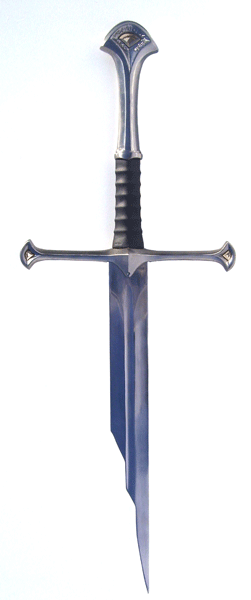
Aragorn II, son of Arathorn II and Gilraen, also known as Strider and Elessar, was the 16th and last Chieftain of the Dúnedain of the North; later crowned King Elessar Telcontar (March 1, 2931 - FO 120), the 26th King of Arnor, 35th King of Gondor and first High King of Gondor and Arnor since the short reign of Isildur. He was a great ranger and warrior. As Isildur's heir, he bore the shards of Narsil, reforged and renamed Andúril ("Flame of the West") in the War of the Ring.
Early years
Aragorn was a descendant of Elros Tar-Minyatur through the line of the Lords of Andúnië to Elendil, High King of Arnor and Gondor. Like all of the kings before him, he was Elrond's kin through the House of Elros. His ancestor Arvedui was wedded to Fíriel, descended from Anárion, who bore their son Aranarth, making Aragorn the last descendant of both Isildur and Anárion.

When he was only two years old, his father Arathorn was killed while pursuing Orcs. Aragorn was afterwards fostered in Rivendell by Elrond. At the request of his mother, his lineage was kept secret, as she feared he would be killed like his father and grandfather if his true identity as the descendant of Elendil and Heir of Isildur became known. Aragorn was renamed "Estel" and was not told about his heritage until 2951.
Elrond revealed to "Estel" his true name and ancestry when he was twenty, giving him the Ring of Barahir and the Shards of Narsil, but withholding the Sceptre of Annúminas from Aragorn until he "came of the right" to possess the item. It was also around this time that Aragorn met and fell in love with Arwen, Elrond's daughter, newly returned from her mother's homeland of Lothlórien where she had been visiting her grandmother Galadriel.
Aragorn thereafter assumed his proper role as the sixteenth Chieftain of the Dúnedain and left the comforts of Rivendell for the wild, where he lived with the remainder of his people, the Rangers of the North, whose kingdom had been destroyed through division and the Angmar Wars centuries before.
Aragorn met Gandalf the Grey in 2956 and they became close friends. Heeding Gandalf's advice, Aragorn and the Rangers began to guard a small land known as the Shire inhabited by the diminutive and agrarian Hobbits, and he became known among the peoples just outside the Shire's borders as Strider.
From TA 2957 to TA 2980, Aragorn undertook great journeys, serving in the armies of King Thengel of Rohan, and Steward Ecthelion II of Gondor. Many of his tasks helped to raise morale in the West and counter the growing threat of Sauron and his allies, and he earned priceless experience which he would later put to use in the War of the Ring. Aragorn served these lords in disguise and his name in Gondor and Rohan during that time was Thorongil ("Eagle of the Star"). With a small squadron of ships from Gondor, he led an assault on the long-standing City of the Corsairs in 2980, burning many of the Corsairs' ships and personally overthrowing the Captain of the Haven during a battle upon the quays. After the victory at Umbar, "Thorongil" left Gondor and, to the dismay of his men, went east.
Later in 2980, he visited Lothlórien, and there once again met Arwen. He gave her the heirloom of his House, the Ring of Barahir, and, on the hill of Cerin Amroth, Arwen pledged her hand to him in marriage, renouncing her Elvish lineage and accepting the Gift of Ilúvatar: Death.
Elrond withheld from Aragorn permission to marry his daughter until such a time as his foster son should be king of "both" Gondor and Arnor. As both Elrond and Aragorn knew, to marry a mortal, Arwen would be required to choose mortality, and thus deprive the deathless Elrond of his daughter while the world lasted. Elrond was also concerned for Arwen's own happiness, fearing that in the end she might find death (her own and that of her beloved) too difficult to bear.
Before the events of The Lord of the Rings properly take place, Aragorn traveled widely through Middle-earth, entering the Dwarven mines of Moria via the East-gate of Moria but exiting the same way. He also journeyed to Harad, where (in his own words) "the stars are strange". Tolkien indicated that these travels occurred after TA 2980, but does not indicate what happened during Aragorn's visits.
In TA 3009, Gandalf grew suspicious of the origin of the Ring belonging to the Hobbit Bilbo Baggins, which later turned out to be the One Ring, the key to the Dark Lord Sauron's power. Setting a guard of Rangers on the Shire, Aragorn went at Gandalf's request into Rhovanion in search of Gollum, who had once possessed the Ring. He caught the creature in the Dead Marshes near Mordor, and brought him as a captive to Thranduil's Halls in Mirkwood, where Gandalf questioned him. Gollum, however, escaped some time later with the aid of Sauron's Orcs.

War of the Ring
Escorting the hobbits
Aragorn returned with Gandalf in the spring of TA 3018, and then went away on his own journey, and was not able to help when Gandalf discovered the Nazgûl were seeking for Frodo and the Ring in the Shire. After Frodo left Hobbiton, Gildor Inglorion informed Aragorn that the Nine were looking for him and Gandalf was missing. Aragorn continued to watch the Great East Road until Tom Bombadil and the four hobbits came from the Barrow-downs. Following them to Bree, he met Frodo at the Inn of The Prancing Pony under the name "Strider," as the Men of Bree called him. Though originally the hobbits were suspicious of him, Barliman Butterbur brought a letter from Gandalf that made them trust him. Aragorn was aged 87 at that time, nearing the prime of life for one of royal Númenórean descent.
After the raid on Bree, Aragorn led the Hobbits out of Bree-land and through the Midgewater Marshes. While there, he saw Gandalf's battle with the Nazgûl on Weathertop from a distance. When they themselves came to Weathertop, they discovered five of the Nazgûl had followed them, and during the later attack he fought off the Ringwraiths. After attempting to heal Frodo with athelas, he led them across the Lone-lands towards the Trollshaws. They met with the Elf-lord Glorfindel who led them to the Ford of Bruinen. When the Nazgûl caught up with them and Elrond released a flood, Aragorn and the Hobbits kindled fire and flushed out those Nazgûl that had remained on the western bank. He then accompanied Frodo to Rivendell.

During the feast of victory, Aragorn was gathering news from Elladan and Elrohir, and later helped his friend Bilbo compose his "Lay of Eärendil". During the Council of Elrond, he revealed himself to Boromir as the heir of Isildur and described his capture of Gollum. After Elrond decided that the Ring must be destroyed in Mordor, Frodo took the burden upon himself. There, Aragorn chose to join Frodo, thus forming the Fellowship of the Ring, tasked with accompanying Frodo in destroying the Ring in the fires of Mount Doom. Besides Aragorn, Gandalf, and Frodo, the company included Frodo's cousins Pippin and Merry, his best friend Sam, Legolas the Elf, Gimli the Dwarf, and Boromir of Gondor.
All that is gold does not glitter, Not all those who wander are lost; The old that is strong does not wither, Deep roots are not reached by the frost. From the ashes a fire shall be woken, A light from the shadows shall spring; Renewed shall be Blade that was Broken, The crownless again shall be king.
Before the group set out, the shards of Narsil were re-forged, and the restored blade was named Andúril.
— Bilbo's poem about Aragorn
Accompanying the Fellowship
Aragorn and Gandalf had been planning their journey to Mordor for weeks. He and Gandalf guided the Fellowship south along the line of the Misty Mountains. When they came to Hollin, Aragorn grew suspicious due to the lack of any sound he heard and spotted the Crebain who were spying out the land for Saruman. He then convinced Gandalf to try the pass over Caradhras. However, while they were still far down the mountain, they were caught in a freak storm brought on by Sauron, and were forced to retreat. Aragorn, together with Boromir, made a path through the snow for the Fellowship to escape.

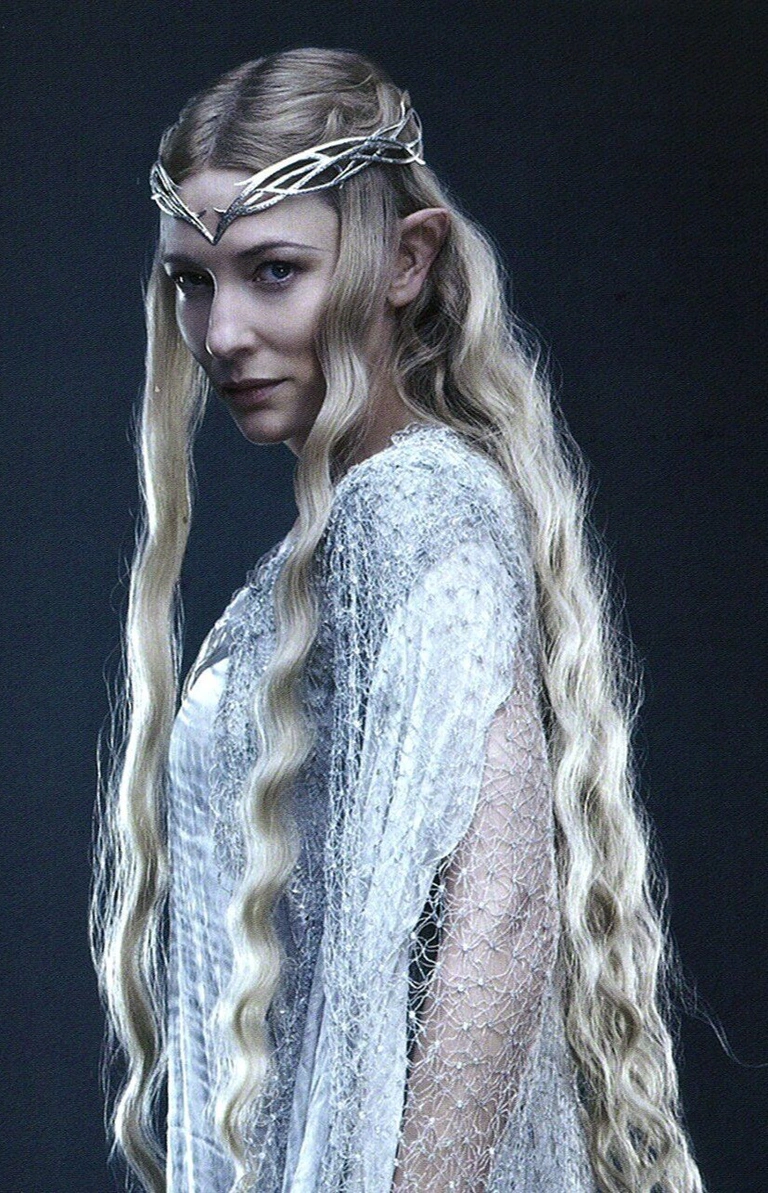
After it was proposed to go through Moria, Aragorn reluctantly agreed to go and helped fight off the Wargs that attacked them during the night. Helping to rescue Frodo from the Watcher in the Water, once the company entered Moria, Aragorn remained at the back and noticed Gollum beginning to follow them. After they were attacked in the Chamber of Mazarbul, Aragorn fought off the attackers and killed the Orc-Chieftain, (or Cave-troll in the movies) that had seemingly killed Frodo. During Gandalf's battle with the Balrog on the Bridge of Khazad-dûm, Aragorn ran to his side and became the Fellowship's leader after Gandalf fell, presumed dead. Aragorn then led the company to Lothlórien, where he visited Cerin Amroth for the last time. At their parting, Lady Galadriel gave him the Elfstone.
After Lórien, Aragorn and the Fellowship sailed down the River Anduin to the Falls of Rauros. Aragorn attempted to catch Gollum several times. Though his original plan was to set out for Gondor and aid its people in the war, he felt responsible for Frodo after the loss of Gandalf and was conflicted about what path to take.
Breaking of the Fellowship
After passing the Argonath, the Fellowship camped at Parth Galen. Frodo saw that Boromir had been driven mad by the influence of the One Ring, trying to take it. Frodo put the Ring on, rendering him invisible, and ran away from Boromir. Frodo climbed to the high seat on Amon Hen; from there he could see Sauron's eye looking for him. The Hobbit felt the eye but the Dark Lord was distracted by Gandalf the White.

At this same time, the others were attacked by Saruman's Uruk-hai and a battle ensued. During the ensuing battle, Boromir was killed defending Merry and Pippin, expressing his remorse privately to Aragorn for trying to take the Ring. After discovering that Frodo had left, Aragorn and the others decided that they would leave Frodo and Sam to rescue Merry and Pippin. Legolas, Gimli, and Aragorn put Boromir's body and war gear in one of the Elven boats as a funeral boat and tribute to Boromir for his bravery and courage. His body would be sent over the Falls of Rauros.
While Frodo continued his quest with Samwise Gamgee, Aragorn, Legolas and Gimli went to Rohan to free Merry and Pippin, who had been captured by the Uruk-hai in Saruman's service.
The Three Hunters
Aragorn ran from Parth Galen across the width of Rohan in just four days. As they approached Fangorn Forest, the "Three Hunters" Aragorn, Legolas, and Gimli encountered Éomer, who had recently pursued and routed an Orc-band in the area. From Éomer, Aragorn learned that the Orcs who had kidnapped Merry and Pippin had been destroyed and that the Hobbits had not been found. Dejected, he led Legolas and Gimli to the site of the battle. Clues led Aragorn to believe that the Hobbits might still be alive, and he led the Three Hunters into Fangorn Forest. They did not find the Hobbits, but they did find Gandalf the White, sent back to continue his struggle against Sauron. Gandalf told the Three Hunters that the Hobbits were safe with the Ents of Fangorn.

Where now are the Dunedain, Elessar, Elessar? Where do thy kinsfolk wander afar? Near is the hour when the lost should come forth, And the Grey Company ride from the North. But dark is the path appointed to thee: The Dead watch the road that leads to the Sea.
- Galadriel's message to Aragorn
The Battle of Hornburg
Together, Gandalf and the Three Hunters travelled to Edoras, where Gandalf freed Théoden from Saruman's enchantment and helped him organize the Rohirrim against Saruman. He allied with Théoden and joined the king's Éored, journeying to Helm's Deep.

Aragorn, Legolas and Gimli then helped the people of Rohan in the Battle of the Hornburg, in which they conclusively defeated Saruman's army. Afterward Aragorn went with Gandalf to Isengard, only to find it in ruins by the work of the Ents. Aragorn, being present with Gandalf, Théoden, Éomer, Legolas and Gimli, negotiated in a final parley with Saruman. Saruman attempted to bend Théoden to his will, and at first the king was almost swayed, but mastering his will he refused to join with Saruman. Saruman also attempted to sway Gandalf, but failed in this also, and even so Gandalf offered his counterpart the opportunity for forgiveness. Saruman refused to repent out of pride and to avoid seeming a rebel to Sauron, and thus Gandalf broke Saruman's staff and banished him from the Order of Wizards and the White Council. After Saruman crawled away, Gríma Wormtongue Wormtongue threw the palantír of Orthanc at Gandalf as he and the others were leaving. He missed, however, unable to decide if he hated Saruman or Gandalf more, and thus ended the Battle of the Hornburg and the destruction of Isengard. After Pippin revealed himself to Sauron in the stone, Gandalf gave the palantír to Aragorn.
Not long after the Grey Company of Rangers arrived from the north, dispatched by Galadriel. With them rode Elladan and Elrohir and Halbarad, bearing a standard made for him by Arwen. When Aragorn returned to Helms Deep, he decided to draw Sauron out and used the palantír to show himself and Andúril to the Dark Lord, wrenching the Stone to his will after a long struggle with the Dark Lord. However, this led Sauron to swiftly send out the forces he had long prepared to attack Minas Tirith.
Return of the King

In order to defend the city, Aragorn travelled the Paths of the Dead, and summoned the Dead Men of Dunharrow who owed allegiance to the Heir of Isildur. It had been prophesied by Isildur and Malbeth the Seer that the Dead would be summoned once more to pay their debt for betraying Gondor an age before. With their aid the Corsairs of Umbar were defeated at the Battle of Pelargir.
Aragorn, a small force of Rangers, and a large contingent of men and soldiers from the southern regions then sailed up the Anduin to Minas Tirith. When they arrived at the Battle of the Pelennor Fields, Aragorn unfurled a standard that Arwen had made for him which showed both the White Tree of Gondor along with the jeweled crown and seven stars of the House of Elendil. With the help of the southern forces the armies of Gondor and Rohan rallied together and defeated Sauron's army.
The Steward Denethor declared that he would not bow to a descendant of Isildur (years before, he had seen "Thorongil" as a rival to his father's favor and soon discovered his true identity) and burned himself to death during the battle, despairing of final victory. Aragorn healed Faramir, Denethor's last heir, Éowyn and Merry, who together slew the Witch-king as well as many others. This won him the immediate recognition of Faramir as rightful heir to the throne; his humility and self-sacrifice gained him the hearts of the inhabitants of Gondor's capital city. Aragorn's healing abilities, moreover, were a sign to the people of Gondor of the identity of their true king; as Ioreth said, "The hands of the King are the hands of a healer, and so shall the rightful king be known." The people hailed him as King that same evening.

Despite his immediate success and popularity, however, and despite his claim to the throne through raising the royal banner, Aragorn decided to lay aside his claim for the time being. He knew that if he aggressively promoted his claim, rival claimants or debates as to his legitimacy were not out of the question, and this could be a fatal distraction for Gondor at a time when the West needed to be united against Sauron. So, to avoid conflict, after he had healed people during the following nights of March 15–16, he left Minas Tirith and symbolically refused to enter it again until he was crowned King on May 1.
Captain of the West
Aragorn then led the Host of the West to Mordor as per the advice of Gandalf and Elrond, to divert Sauron's attention from Frodo and Sam. They marched over the Anduin river and came to Minas Morgul, and set fire to the fields there. Leaving a guard at the Cross-roads of the Fallen King, they began to march north along the North Road of Ithilien, and Aragorn won a skirmish against some Orcs and Easterlings that tried to ambush them. They then reached the desert before Mordor, and Aragorn allowed those who were afraid to depart to retake Cair Andros. The Army of the West then reached the Black Gate, and Aragorn along with Gandalf, Éomer, Imrahil, Pippin, Legolas and Gimli rode up to it and called for Sauron to come forth. He then watched as the Mouth of Sauron revealed Sauron knew about Frodo and Sam, and saw Gandalf's rejection of Sauron's terms. The Host of the West was then encircled by Sauron's forces, a vast army of Orcs and Men. Aragorn then arranged the Army of the West defensively on two Slag-hills and the Battle of the Morannon began.
After the destruction of the Ring and the defeat of Sauron, Aragorn freed the slaves of Núrn and gifted them the entire land in southern Mordor.
As King of Reunited Gondor and Arnor
Upon Sauron's defeat, Aragorn was crowned as King Elessar, a name given to him by Galadriel and adopted by the people of Gondor because of the Elfstone he wore. He became the twenty-sixth King of Arnor, thirty-fifth King of Gondor, and the first High King of the Reunited Kingdom, though it would be several years before his authority was firmly re-established in Arnor. His line was referred to as the House of Telcontar (Telcontar being Quenya for "Strider"). Aragorn married Arwen shortly afterwards, and ruled the Kingdom of Gondor and Arnor until 120 of the Fourth Age. His reign was marked by great harmony and prosperity within Gondor and Arnor, and by a great renewal of cooperation and communication among Men, Elves, and Dwarves, fostered by his vigorous rebuilding campaign following the war. Aragorn led the forces of the Reunited Kingdom on military campaigns against some Easterlings and Haradrim, re-establishing rule over all the territory that Gondor had lost in previous centuries.

During his coronation, Aragorn spoke Elendil's Oath: "Et Eärello Endorenna utúlien. Sinome maruvan ar Hildinyar tenn' Ambar-metta!" ("Out of the Great Sea to Middle-earth I am come. In this place, I will abide, and my heirs, unto the ending of the world.")
End of Reign and Death
When in the year 120 of the Fourth Age, King Elessar realised his days were at an end, he went to the House of the Kings in the Silent Street. He said farewell to his son Eldarion and his daughters and gave Eldarion his crown and sceptre. Arwen remained at Aragorn's side until he died. A year after Aragorn's death, Arwen died in Lothlórien of a broken heart. Eldarion began his reign as the second King of the Reunited Kingdom after his father's death.

Character
Tolkien gives this description of Aragorn in The Lord of the Rings: lean, dark, tall, with "a shaggy head of dark hair flecked with grey, and in a pale stern face a pair of keen grey eyes."

In The Tale of Aragorn and Arwen, he was said to be often grim and sad, with unexpected moments of levity. Some time after the publications of the books, Tolkien wrote that he was six feet six inches tall.
Aragorn possessed Elven wisdom due to his childhood in Rivendell with Elrond and the foresight of the Dúnedain. He was also a skilled healer, notably with the plant athelas (also known as Kingsfoil). He was also a mighty warrior and an unmatched commander; after the Battle of the Pelennor Fields, he, Éomer, and Imrahil were said to be left unscathed, even though they had been in the thick of the fighting.
Though there is no indication of his ever doubting his role and destiny as the future king of the Reunited Kingdom and one of the leaders of the war against Sauron (as he did in Peter Jackson's film), he was not immune to self-doubt, as he doubted the wisdom of his decisions while leading the Fellowship after the loss of Gandalf in Moria, and blamed himself for many of their subsequent misfortunes.
On one occasion his reverential pride for his heritage as caused complications as he refused to disarm and leave his sword Andúril at the door of Edoras as Théoden had required. Aragorn even vocally questioned how the authority of Théoden could supersede his own lineage from that of Elendil. Aragorn only acquiesced after Gandalf called out his hubris as only benefiting their enemies well as highlighting that he would surrender his own sword if it meant meeting Théoden. Even so, Aragorn swore that death would come somehow to anyone else that touched it.
He also appeared to possess a nigh-indomitable will. At one point, he was able to psychically challenge Sauron for control of the palantír of Orthanc, and proved victorious in that struggle. It should be noted that even Gandalf the White was reluctant to use the palantír for fear of challenging Sauron directly and revealing himself to the Dark Lord. His fortitude in the face of the Dead Men of Dunharrow was unwavering and his companions remarked that he was mighty indeed in the strength of his will. He was accounted as "the hardiest of living Men" during his lifetime.
Note on lineage
The restoration of the line of Elendil to the throne of Gondor is a subplot of The Lord of the Rings; Aragorn's adventures not only aid Frodo in his Quest, but also bring him closer to his own kingship which, though his by right and lineage, has been left open for centuries due to historical, legal, and military circumstances. The people of Gondor have been under the rule of the Stewards of Gondor for nearly a millennium, as it was widely doubted that any of the royal line still lived. After the Disaster of the Gladden Fields, Meneldil, son of Anárion, had severed Gondor from Arnor politically, although the formal title of High King remained with the northern line (as Isildur was Elendil's eldest son). This arrangement had been reinforced by the Steward Pelendur after nearly 2,000 years when he rejected Arvedui's claim to the throne of Gondor during a succession crisis (Eärnil, a member of the House of Anárion, was eventually chosen as King instead). Notably, Arvedui had also based his claim on the fact that he had married a descendant of Anárion: thus, Aragorn was technically a descendant of not only Isildur but of Anárion as well.

History & mythology
Richard J. Finn presented a paper entitled "Arthur and Aragorn - Arthurian Influence in LOTR at the Forty-First International Congress on Medieval Studies". The are additional similarities between Aragorn and Arthur beyond those pointed out by Finn. Arthur is descended from Kings of Goddodin - Coel Hen, Aragorn becomes King of Gondor. Kings of the period in Goddodin lived at both Traprain Law and Din Eidyn (Edinburgh, still known as Dùn Éideann in Scottish Gaelic) remarkably similar to Dúnadan. For "Men of the North", Goddodin was a far northern kingdom. Arthur was crowned by St. Dubriticus, who wore a long grey robe for which he was called "His Grey Eminence" - Gandalf the White also wore a grey robe at Aragorn's coronation to indicate he at one time was Gandalf the Grey.
The Lord of the Rings film trilogy
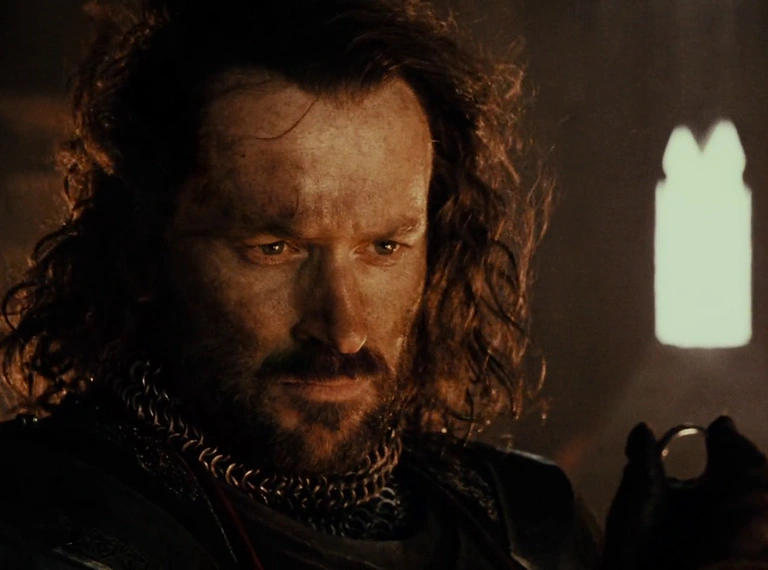
In The Lord of the Rings movie trilogy (2001 – 2003) directed by Peter Jackson, Aragorn is played by Danish-American actor Viggo Mortensen, who took over the role from Stuart Townsend after a month of rehearsals. In these movies, Aragorn must overcome his self-doubt to claim the kingship. This specific element of self-doubt is not present in Tolkien's books, where Aragorn intends to claim the throne all along. Daniel Day-Lewis was offered the role, but declined. Russell Crowe was also offered the role, but likewise declined.

In The Lord of the Rings: The Two Towers, Aragorn takes on a greater role as the main protagonist. The movie sees him accept his title as king by inspiring, assisting and commanding his subjects, alongside Legolas and Gimli. Aragorn aids Théoden and Rohan in the campaign against Saruman and Isengard. He risks his life to inspire and save the world he had rejected; commanding Men and Elves in the Battle of Helm's Deep to battle Saruman's army of Uruk-hai. At the end of the film, Aragorn encourages Théoden King to ride out and meet the enemy head on. With Gandalf's intervention, the Uruk-hai are overwhelmed and slayed. He is last seen watching over Isengard.
In the film, Théoden's niece, Éowyn, develops romantic feelings for him, but he takes her lightly, as he loves Arwen. After the battle, Éowyn is overjoyed to see that Aragorn has survived, and embraces him.
In order to ensure safe passage across Mordor for Frodo to fulfill his quest, Aragorn then led the Army of the West out from Minas Tirith to make a diversionary feint on the Black Gate of Mordor itself in the Battle of the Morannon. Gandalf had been given supreme command of the war effort after the Pelennor Fields, and acted as chief spokesman in the parley with the Mouth of Sauron; but Aragorn commanded the Allied troops during the battle and its aftermath.
Non-canonical weapons
In the film adaptation, Aragorn never carries the shards of Narsil as he did in the books, and only receives the reforged Andúril before entering the Paths of the Dead. Up until this time, Aragorn uses a different, more basic sword that is never given a name. Attached to the scabbard of this sword is a small utility knife that Aragorn uses in the wild country.

Aragorn also uses a long, curved dagger in battle, though a lot less frequently than his sword. This dagger is used for close combat and as a last resort if the sword is useless in a particular situation, such as when Aragorn is knocked down or assassinating Sauron's servants. He received a curved dagger from Celeborn in the movie, upon leaving Lothlórien. In The Lord of the Rings: The Return of the King video game, Aragorn uses his dagger as a finishing blow for his Final Judgment and Warrior Bane combos.
Near the end of the first movie The Fellowship of the Ring, in the scene where Aragorn fights the Uruk-hai Captain Lurtz, Aragorn uses his sword to deflect his Elvish dagger, which Lurtz threw at him after he stabbed him in the leg with it. This was not meant to happen as in the original script the knife was supposed to miss and hit the tree behind Aragorn, though the mask Lurtz's actor was wearing restricted his vision, causing him to miss his mark and throw the knife directly at Aragorn. Luckily he was able to use his sword to deflect the knife just in time. Peter Jackson decided to keep that scene rather than the one originally planned.

Aragorn's next weapon in his arsenal is his bow. This bow is rarely used at all. Aragorn only uses it in Moria, shooting Goblins in the beginning of the Battle of the Bridge of Khazad-dûm and while fleeing the Bridge of Khazad-dûm. During these few scenes, Aragorn shows that, though he does not have the expert bow skill and speed that Legolas possesses, he is still an effective shooter when he successfully brings down two goblins through small cracks in the door.
In The Two Towers and The Return of the King video games, Aragorn's missile weapon is his bow and arrows. In each case, Aragorn has 30 arrows.
Aragorn's final weapon is the Black Stone. He uses it once in The Return of the King to summon the Oathbreakers and defeat the Corsairs of Umbar. He is not shown using it in the movie adaptation.
In The Lord of the Rings: Conquest, Aragorn's special, heavy attack is to summon the Army of the Dead.
In The Lord of the Rings: The Battle for Middle-earth II, Aragorn's most powerful ability is to summon the Army of the Dead, which appears as four abnormally large, invincible ghost units, who can kill infantry almost instantly, though they are weak against buildings. The only units capable of doing any sort of damage to the Dead are heroes, which even then get immediately wiped out.
Bow and arrows
The Black Stone
The Hobbit film trilogy
While not appearing physically in Peter Jackson's The Hobbit film trilogy, he is alluded to by Thranduil to Legolas in The Hobbit: The Battle of the Five Armies. In a departure from the books, he is stated to already be a Ranger and well known among his people, rather than a ten year old child. Thranduil only told him that the Ranger's name was Strider and that he was the son of Arathorn, telling him that he would have to find out Strider's true name for himself.
Given that Aragorn was 87 in The Two Towers, he would have been 27 during The Hobbit film series, since the original trilogy omitted the 17 year gap between where Gandalf leaves Frodo and finds out about the Ring's origin.
The Lord of the Rings: The Hunt For Gollum
Aragorn's portrayal and travels in The Lord of the Rings: The Hunt for Gollum are not fully known, but he one of the major characters and the movie is supposed to be set between the Bilbo's 111th birthday party in The Shire and when Gandalf returns to Bag End to confirm that Frodo still has the Ring.
After Gandalf's suspicions about the nature of Bilbo's Ring made him suspect it might be the One Ring, commissions Aragorn to search for Gollum in the hopes of catching him for interrogation. The descriptions from limited sources about the movie, suggest Aragorn also gets some fellow Rangers of the North (possibly from the Grey Company and Elrond's sons) to aid his search. If his hunt follows the books, he guesses correctly that Gollum has traveled east from the Misty Mountains, but his pursuits were largely fruitless for several years, until he by chance catches Gollum in the Dead Marshes. The hope was that Gollum could be caught before he was interrogated by Sauron, but Aragorn caught him after, unfortunately. Despite this, Aragorn takes Gollum to Thranduil's Halls where Gandalf eventually comes to interrogate Gollum. It seemed that Aragorn left before Gandalf arrived, but what he did was not fully known, but perhaps he went looking for Frodo.
Jamie Dornan is set to portray "Strider" in The Lord of the Rings: The Hunt for Gollum, replacing Viggo Mortensen as the previous actor in live-action adaptations.

Ralph Bakshi version of The Lord of the Rings
Aragorn was voiced by John Hurt in Ralph Bakshi's 1978 animated film version of The Lord of the Rings. Bakshi's Aragorn, unlike all other portrayals that were to follow to date, has no beard. This actually conforms to a statement appearing in Unfinished Tales of Númenor and Middle-earth that implicitly says that Aragorn was not supposed to have one, due to his Elvish ancestry (Elves did not grow beards). In a note written in 1972 or later, among the last writings of my father's on the subject of Middle-earth, there is a discussion of the Elvish strain in Men, as to its being observable in the beardlessness of those who were so descended (it was a characteristic of all Elves to be beardless. However, Tolkien actually wrote elsewhere that Elves did have beards; in The Lord of the Rings itself Círdan is described as having a beard. Also, some viewers and critics have said that this version of Aragorn looks Native American though not necessarily to the detriment of the film.

In Rankin/Bass' Return of the King
Aragorn was voiced by Theodore Bikel in the 1980 Rankin/Bass animated version of The Return of the King, made for television. He first appears at the Battle of the Pelennor Fields, leading the reinforcements from southern Gondor.
On stage
Aragorn was portrayed by Evan Buliung in the three-hour production of Lord of the Rings: A Musical Tale, which opened in 2006 in Toronto, Canada. A scaled down revival, Lord of the Rings: A Musical Tale, also featured Aragorn.
In the United States, Aragorn was portrayed by Josh Beshears in the Cincinnati, Ohio production of The Return of the King (2003) for Clear Stage Cincinnati. At Chicago's Lifeline Theatre, Aragorn was played by Robert McLean in the 1999 production of The Two Towers.
• Also see the Wikipedia stage article: The Lord of the Rings (musical)
Born of Hope fan film
In the fan-film Born of Hope, Aragorn appears as a two-year-old toddler played by the child actor Luke Johnston.
In radio
• Godfrey William Kenton voiced the character in the 1955 BBC Radio radio adaptation of The Lord of the Rings.
• Tom Luce voiced the character in the 1979 The Mind's Eye radio adaptation of The Lord of the Rings.
• Robert Graham Stephens voiced the character in the 1981 BBC Radio serial of The Lord of the Rings.
• Hans-Peter Hallwachs voiced the character in the 1991-1992 German radio serial adaptation of The Lord of the Rings.
• Boris Farkaš voiced the character in the 2001-2003 three-season Slovak radio serial adaptation of The Lord of the Rings.
Voice dubbing actors
Foreign Language Voice dubbing artist - Japanese Hōchū Ōtsuka (大塚 芳忠) - Korean (SBS TV Edition) 이정구(Jung-Goo Lee)(The Fellowship of the Ring)/안지환(Ji-hwan An)(The Two Towers & The Return of the King) - French (Québec) Jacques Lavallée - French (France) Bernard Gabay - Spanish (Latin America) Sergio Gutiérrez Coto - Spanish (Spain) Juan Antonio Bernal - Catalan - German Jacques Breuer - Italian Pino Insegno - Polish Marek Barbasiewicz (1978) - Portuguese (Brazil) (Television/DVD) Affonso Amajones - Turkish Boğaçhan Sözmen - Czech Michal Dlouhý - Slovak Pavel Višňovský - Hungarian Selmeczi Roland † - Russian Aleksei Ryazantesv (Рязанцев, Алексей Анатольевич) - Ukrainian Michael Zhonin (Михайло Жонін) - Mandarian Chinese (China / Taiwan) Kui Lu (陆揆) - Cantonese Chinese (Hong Kong) Luo Ooa (羅偉傑) - Thai Uttaporn Teemakorn (อรรถพร ธีมากร) (Kapook, Films 2-3) Wanchai Paowiboon (วันชัย เผ่าวิบูลย์) (Channel 7) - Persian Saeed Mozafari (سعید مظفری)
Sources
Adapted from the original article, under CC BY-SA 3.0.