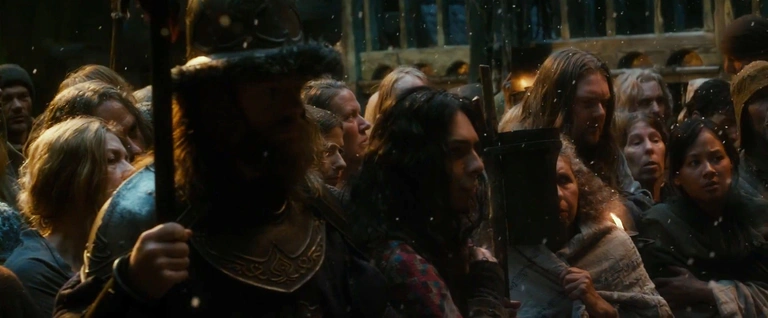
Group
Rohirrim
The Rohirrim were a people of Northmen descent who inhabited the realm of Rohan…

They are proud and willful, but they are true-hearted, generous in thought and deed; bold but not cruel; wise but unlearned, writing no books but singing many songs, after the manner of the children of Men before the Dark Years.
The Rohirrim were a people of Northmen descent who inhabited the realm of Rohan in central Middle-earth. The names Rohirrim and Rohan referred to their famous horsemanship.
Description & culture
The Rohirrim were a tall, blond, and mostly blue-eyed people. They were noble, brave, strong-willed, and fiercely independent, remaining within their own language and culture. Their horses were important, everyday assets, with their entire culture based around the breeding and trading of them. As an agrarian people, they built few cities living mainly in scattered villages and towns on the plains. Its capital and most populous settlement was the hilltop city of Edoras.
History
The Rohirrim were descended from the Northmen of Rhovanion and the Éothéod, who lived in the vales of the Great River Anduin but were removed to Calenardhon around the early to middle third age, a plains-land granted them in perpetuity by the Ruling Steward of Gondor, Cirion, in reward for the assistance that they offered Gondor at a time of great need. As a result, they were lifelong allies of Gondor bound by the Oath of Eorl. At that time Calenardhon was renamed Rohan ("Horse-land") after their many horses. By the Rohirrim themselves Rohan is usually called "The Mark".
The terms Riders of Rohan and Riders of the Mark are commonly used to refer to horsemen of Rohan. The former is a chapter title in The Two Towers. The "King's Riders" were specifically the horsemen who formed the king's bodyguard.
The plains of Rohan, provided the Rohirrim ample land for the breeding and feeding of vast horse herds. Indeed the Rohirrim horses were famed across Middle-earth for their speed, stamina and courage. Qualities mirrored by their riders, who trained and saddled their mounts from an early age. It is said that a Rohirrim male loved only two things in his life. He loved his maiden and his steed.
The Dúnedain of Gondor believed that the Rohirrim were distantly related to them (having descended from the Atanatári of the First Age) and described them as Middle Men, that being inferior to the Númenóreans in both culture and descent, but superior to the "Men of Darkness" who had worshiped and served Sauron.
The Rohirrim had contacts with Elves in their ancient years, and knew of Eru, but, like the Dúnedain, they did not worship him corporately. They seem to have highly valued the Vala Oromë the Hunter, whom they called Béma.
During the reign of Théoden, the largest assembled host of Rohirrim, mustered at the camp of Dunharrow, became crucial in saving Gondor and Minas Tirith from utter destruction by Sauron's host, at the Battle of the Pelennor Fields in TA 3019. Following that and the death of Théoden, many of them rode to Mordor, under Aragorn's lead, and fought courageously at the Battle of the Black Gate, without certainty that the One Ring would be successfully destroyed.
Following the downfall of Sauron, and the reformation of a United Gondor, Rohan entered into a time of great bounty and peace. Led by King Éomer, the kingdom renewed the Oath of Eorl with its age-old ally Gondor under King Elessar, and continued on.
Anglo-Saxon connection
The Rohirrim seem to resemble the ancient Anglo-Saxons, a Germanic people comprising three tribes, the Angles, the Saxons, and the Jutes, who invaded and conquered Britain around the 5th century, providing the initial basis for the English people and civilisation. J.R.R. Tolkien was himself a distinguished professor of the Anglo-Saxon language (Old English).

The people of Rohan resemble the Anglo-Saxons in several ways. In appearance they are fair skinned and mostly blond haired, like the Germanic invaders, but they also have cultural links to those ancient tribes. This is shown in the type of armour used by Rohirric warriors, which includes an extensive choice of mail, both chain and scaled, and in their reverence for the sword as an expensive yet symbolically important weapon, to be given a title and passed down through generations.
Rohirric armies are also known to favour the shield-wall, which was a strategy commonly employed by the Anglo-Saxons. Finally, common names given to the people of Rohan tend to resemble names of Old English. For instance, the name Éomer is found in the Beowulf saga (an epic Tolkien built much of his career around), and means "horse-famous" in Old English. While these traits of the Rohirrim could be passed off as typical of any agricultural, Northern society of Europe, such as the Vikings, taken as a whole and with the knowledge that Tolkien was an acclaimed professor of Anglo-Saxon and indeed had set out to create a uniquely "English" mythology, it can be inferred that the descriptions of the Rohirrim were heavily drawn from those of the ancient Anglo-Saxons.
However one aspect of the Rohirrim, their close affinity to horses as beasts of warfare and their extensive and superb use of cavalry, is not a trait that is known to be shared with the ancient Anglo-Saxon tribes, who were predominately foot-soldiers in wartime. (It was, however, characteristic of the Ostrogoths, a Germanic tribe that dominated eastern Europe during the late Roman period, whose language was also studied by Tolkien. There have also been recent discoveries regarding the Anglo-Saxons and their apparent close links to horses, though what use they made of them in battle is still debated.) Tolkien's choice to represent the Northern-descended Rohirrim as a horse-loving people is in itself quite interesting, but is obviously part of his unique mythology. Yet it has been argued that one possible reason for the horse inclusion is the events of 1066 in England. According to Tom Shippey, Tolkien imagined the Rohirrim to be a horse-culture because the only surviving Anglo-Saxon words for color were all words for the colors of horses.
At this point the Anglo-Saxons were defeated by the invading Normans, who were able to win the battle through their superior use of cavalry. Therefore, it has been stated that this inclusion may an idea influenced by this, that if the Anglo-Saxon had been horse-lords they could have won the Battle of Hastings thus preserving the Anglo-Saxon culture which Tolkien enjoyed. Certainly, whether the Rohirrim truly are partly or wholly based on the Anglo-Saxons can be a topic of debate among Tolkien fans and scholars.
It should also be noted in Brittany, France, there exists the ancient House of Rohan; providing a possible Norman or French etymological link to the name of the civilisation, or perhaps even Brythonic (British Celtic) since the House of Rohan claimed descent from Brythonic tribes who fled Britain during the Anglo-Saxon invasion. This house however, also took part in the Normal Conquest, which may have been where Tolkien first heard the name. Tolkien personally denied any inspiration for the Rohirrim themselves from this house however; He simply 'liked the shape' of the name.

Sources
Adapted from the original article, under CC BY-SA 3.0.