Group
Northmen
The Northmen, also known as the Free Men of the North, were a race of Men from…
The Northmen, also known as the Free Men of the North, were a race of Men from northern Middle-earth that lived around Rhovanion, and were friendly to Gondor.
History
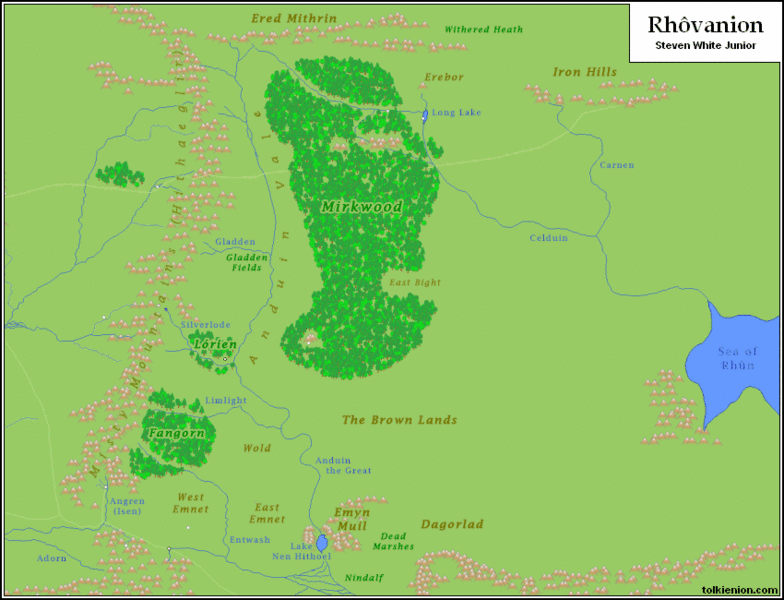
The Northmen who dwelt east of the Greenwood (later named Mirkwood) and other parts of Rhovanion were friendly to the Dúnedain and were, after the Dúnedain, some of the most noble Men in Arda. They were known as Middle Men by the Dúnedain, and were believed to have been descended from the same group of Men as the Edain, the Atanatári. The only difference was that they did not cross the Blue Mountains into Beleriand, and therefore did not journey to Númenor. The result of them not participating in the war against Morgoth was their considerably shorter lifespan; the lifespan of the Dúnedain being lengthened by the Valar after the War of Wrath.

In the Third Age they were important allies of Gondor and served as a buffer against the Easterlings and other foes. For a time many of them even became subjects of Gondor, as the realm extended beyond the River Anduin.
The main Northmen principalities lay east of Greenwood and in the centuries when Gondor's power was at its height the Northmen flourished under its protection. In the fourteenth century of the Third Age, King Rómendacil II of Gondor sent his son Valacar as an ambassador to Vidugavia, the so-called "King of Rhovanion". Valacar loved Rhovanion and the daughter of the King, Vidumavi. He married her and she bore him a son whom she called Vinitharya in her mother tongue. In Gondor, Vinitharya became known as King Eldacar and caused a civil war, the Kin-strife, because of his mixed Dúnedain/Northmen blood.
In the 19th century of the Third Age a group of Northmen, who called themselves the Éothéod, moved to the Vales of Anduin between the Gladden Fields and Mirkwood, fleeing from the Wainriders, who had enslaved much of the people of Rhovanion. After the Witch-realm of Angmar was defeated by Gondor and the remains of Arnor, the Éothéod moved north in TA 1977 to the land near the sources of the Anduin. They were skilled horse breeders and horsemen. In TA 2510 they responded to a plea of help from Gondor against the Balchoth, rescuing the trapped Gondorian army at the Battle of the Field of Celebrant. After they helped Gondor win this important victory, they were rewarded the province of Calenardhon and became known as the Rohirrim.
The Men of Dale and Lake-town were also counted under the Northmen, as were the Woodmen of Western Mirkwood and Rohirrim of Rohan. Most of Rhovanion had been depopulated after the Great Plague and the Wars of the Wainriders. Their range was extremely wide; the Men of the North ranged from the Beornings living close to the western eaves of Mirkwood to those near the southern slopes of the Grey Mountains and from the Long Lake to Dorwinion on the Sea of Rhûn.
In The Hobbit, these Men carved out a potentially precarious living in the eaves of Mirkwood, living as hunters, loggers, trappers, and fishermen on the Anduin and its tributaries. They also lived in constant fear of attack from Dol Guldur.
Languages
In the Third Age, the Northmen spoke the Common Speech, however, they also had native languages. For example, the Rohirrim spoke Rohanese, for which J.R.R. Tolkien appears to have been inspired by Old English, seeing names like "Éowyn" and "Thengel". Whereas the Bardings and Woodmen spoke a similar language to the Men of Rohan in terms of gross language group, as seen in Old Norse] names (akin to Old English and Norse being in the same language group), i.e. the name "Brand" translating to "torch". The language was not similar to Khuzdûl; rather the Dwarf names appearing in The Hobbit and The Lord of the Rings are Dwarf names given in the Northern language of the Dale-men and Lake-men, not the native Dwarf language. They never shared languages with the Elves or with their Western, Southern, and Eastern counterparts; other than Westron.
Sources
Adapted from the original article, under CC BY-SA 3.0.