Place
Sea of Rhûn
Large, inland sea located in eastern Middle-earth
The Sea of Rhûn was a large, inland sea located in eastern Middle-earth.
Geography
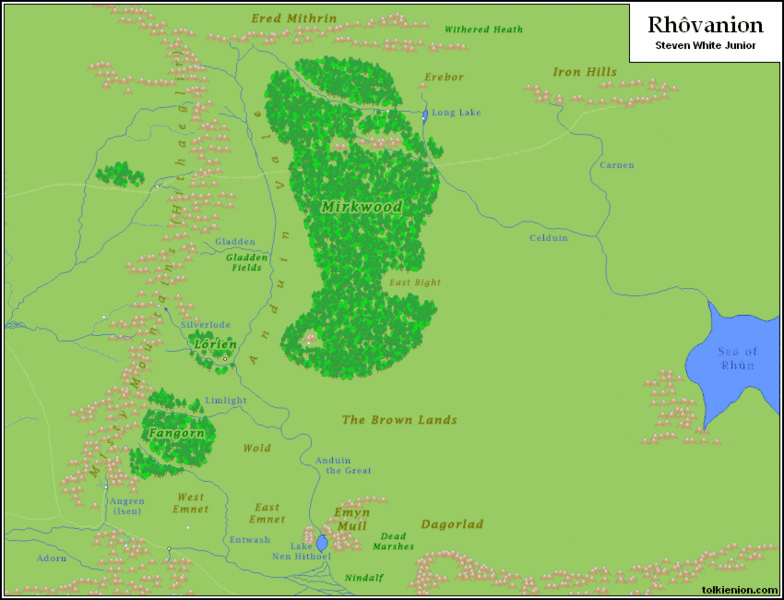
The Sea of Rhûn was located in the west of the land of Rhûn, which was east of Rhovanion and north of Mordor. The River Running, flowing from the Lonely Mountain, and the River Redwater from the Iron Hills, fed the sea. The sea also contained a small, wooded island measuring about thirty miles along the southeastern and northwestern coasts and twenty upon the northeastern and southwestern coasts. According to The Atlas of Middle-earth, the island was about seventy-five miles across.
There were unnamed highlands on the southwest side of the sea and a beech-forest known as Neldoreth on the northeast side. Northwest of the sea was Dorwinion, a land of great gardens, vast vineyards and renowned wines. The Kine of Araw, wild, white cattle, were known to live near the sea's shores. The Great Horn of Gondor was made from the horn of one of these kine that had been hunted by Vorondil, a Steward of Gondor.
History
During the Great Journey, the Telerin Elf Nowë started to develop his skills in building ships on the shores of the Sea of Rhûn. Also the Edain of the House of Bëor and of the House of Marach dwelt near the Sea of Rhûn before to continue their migration across the Rhovanion and the Eriador.

When Gondor was at the height of its power during the reign of King Hyarmendacil (TA 1015 - TA 1149), the realm extended east as far as the Sea of Rhûn. But as Gondor's power waned, Easterlings came into the area around the Sea of Rhûn and launched attacks on Gondor. In TA 1248, Minalcar (later called Romendacil) defeated an army of Easterlings between Rhovanion and the Sea of Rhûn and destroyed their settlements.
In TA 1944, an army of Wainriders gathered on the southern shores of the Sea of Rhûn before launching an assault on Gondor that left King Ondoher dead.
During the War of the Ring, forces under the rule of Sauron mustered in the lands beyond the Sea of Rhûn. In the decades after the downfall of Sauron, Aragorn and Éomer rode beyond the Sea of Rhûn to enforce peace with the Easterlings.
Formation
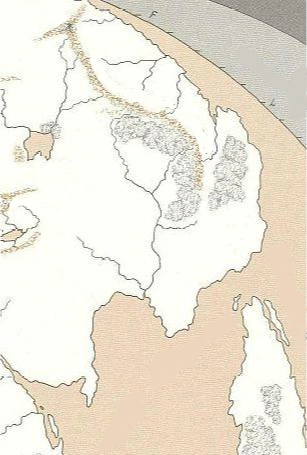
As well as the rest of the whole easternmost portion of Middle-earth, also called Palisor, information about the Sea of Rhûn is few and vague. In fact, because it was not depicted in the maps of Ambarkanta, The Atlas of Middle-earth by Karen Wynn Fonstad proposed that the Sea of Rhûn, along with the Sea of Núrnen, was a remnant of the Sea of Helcar, that was drained in the Belegaer as a consequence of the War of Wrath. However, in The Peoples of Middle-earth, the twelfth volume of The History of Middle-earth that was published after the Atlas, is clear that the Sea of Rhûn existed already in the First Age. A second theory was proposed in The War of the Jewels, the eleventh volume of the History, by Christopher Tolkien, who have speculated that the Sea of Rhûn might "[...] be identified with the Sea of Helcar, vastly shrunken". Overall, J.R.R. Tolkien left the exact relationship between the inland seas of eastern Middle-earth unclear.
In adaptations
In the mobile game The Lord of the Rings: Rise to War, near the western shore of the Sea of Rhûn exists the city of Kineland, presented as the most important city of the Easterlings.
Sources
Adapted from the original article, under CC BY-SA 3.0.