Group
Beornings
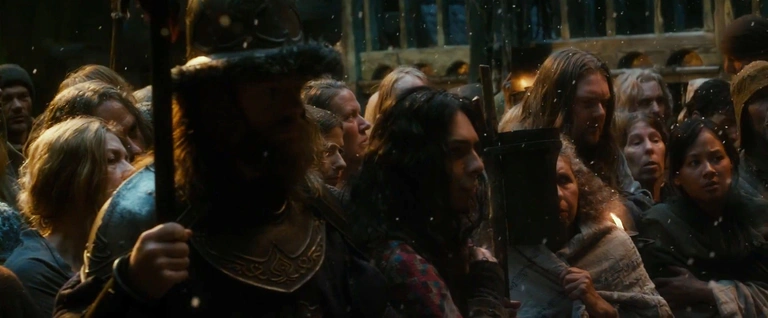
Beornings were sturdy Northmen that lived east of Rivendell between the Misty…
Beornings were sturdy Northmen that lived east of Rivendell between the Misty Mountains and Mirkwood in the upper Vales of Anduin on both sides of the river.
History
The Beornings were Northmen, and as such, were descendants of the Edain or their close kin. Specifically, they were closely related to the Men of Éothéod, who were most nearly akin to the House of Hador.
In the late Third Age, after the Battle of Five Armies and the decimation of the Northern Orcs, many Northmen gathered around Beorn who became a great chief in the upper Vales of Anduin. It is possible that they were named Beornings because they were the descendants of the people whose chief was Beorn.

The Beornings kept open the passages of the Ford of Carrock and the High Pass in return for tolls which, according to Glóin, were too high. They likely kept the paths clear of creatures such as Orcs and Wolves.
In the years leading up to the War of the Ring, the Beornings helped Aragorn, who was taking Gollum to Mirkwood, to cross the Anduin near the Carrock. They also aided Glóin and Gimli on their journey to Rivendell.
During the War of the Ring, Grimbeorn, son of Beorn, was the leader of the Beornings. It is possible that Sauron's forces had attacked them on February 26 in the year 3019 because Frodo Baggins saw many things from afar, including the land of the Beornings aflame, when he wore the One Ring on the Seat of Seeing upon Amon Hen. This hints at an attack by Sauron's forces upon the Beornings, though the outcome of this attack is untold.
After the War of the Ring, the Beornings and the Woodmen of Western Mirkwood were given the central Eryn Lasgalen between the Mountains of Mirkwood and the Narrows of the Forest by Thranduil and Celeborn.
Characteristics
The language of the Beornings was related to Adûnaic and its descendant, Westron. They also spoke Westron as a second language of intercourse.
Through many generations, the descendants of Beorn were skin-changers like him, being able to change into the shape of a bear and could speak in both the tongue of Men and of bears. However the origin of this ability is unknown. Beorn "[was] under no enchantment but his own" according to Gandalf. Some of Beorn's descendants were grim and even "bad" though most had personalities like Beorn; none of them matched Beorn in size and strength. It is untold if all Beornings came from the line of Beorn, and thus, were Skin-changers.

The Beornings seemed to have shared a dislike for Dwarves, perhaps related to the latter's praise of metals and the former's disinterest in it. The Beornings possessed very fine and beautiful animals, and Bilbo says in The Hobbit that Beorn's bees were so big that if they were to sting him, he would swell up like a balloon. They seemed to have the same life-span of mortal Men. It was believed in legend that the Beornings might have originated in the Misty Mountains. They were bitter enemies of the Northern Orcs.
The Beornings hunted neither bird nor beast and their diet consisted mostly of cream and honey. Gimli regarded the Beornings as the best bakers he knew due to their honey-cakes, which was similar to cram in that it was nourishing and made to travel but was tastier. However, the Beornings were reluctant to share them with travelers around the time of the War of the Ring.
The One Ring roleplaying game
In The One Ring role-playing game in 2011, Beornings are one of the playable cultures. The game describes them as rough Men, sometimes outlaws, gathered under the banner of Beorn. One of their cultural Virtues is the ability to take control of a "spirit animal" whilst sleeping, a talent taught to some Beornings by Beorn himself.
The Hobbit: The Desolation of Smaug
In Peter Jackson's The Hobbit: The Desolation of Smaug in 2013, Beorn tells Thorin and Company that in the past Azog hunted him and his people for sport and that, as a result, few of his kind are left. It is one of his prime motivations to help them in the Quest of Erebor.
Sources
Adapted from the original article, under CC BY-SA 3.0.