Place
Blue Mountains
Mountain range situated in the far west of Eriador and the far east of Beleriand
Early Arda
The Blue Mountains arose sometime after the tumultuous chaos caused by Melkor's destruction of the Two Lamps that destroyed the perfect symmetry of Arda Alahasta. In these early days, the Blue Mountains were located between the newly formed great sea of Belegaer and the newly formed Sea of Helcar. The Blue Mountains were connected to the Iron Mountains to the north and the Red Mountains in the east which formed one great mountain range chain known by different names. The Grey Mountains were to its south separated by a great gap.
Elder Days
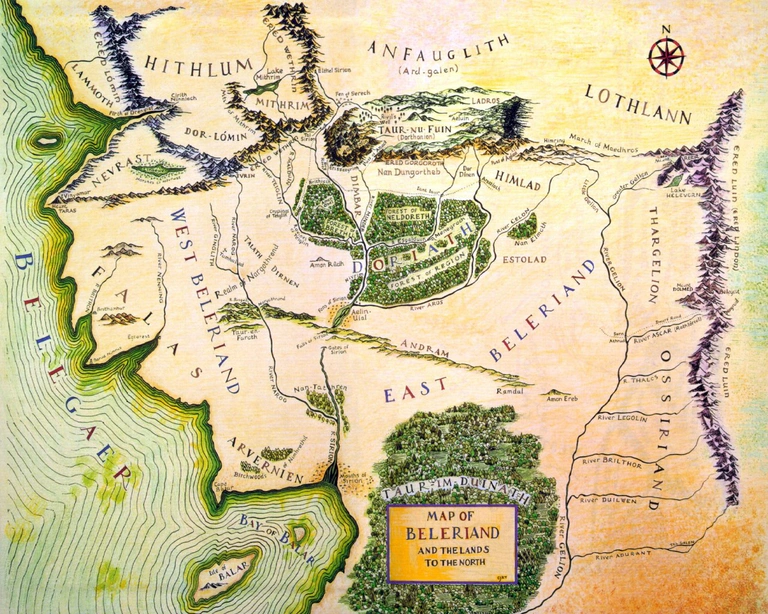
During the Years of the Trees and the Long Night, the Blue Mountains was an unbroken line separating Eriador from Beleriand. Seven rivers arose in it on the western side, and the land these rivers flowed through was known as Ossiriand, the land of seven rivers. Dwarves migrated here from their awakening point and delved the cities of Belegost and Nogrod and made contact and alliance with the Sindar of Thingol.
Second Age
The mountain range was broken during the War of Wrath of the Valar against Morgoth, and at the middle of the range the sea broke through, creating a great gap where was set the Gulf of Lune where the river Lune flowed into the sea. In the middle of the gap, where the Lune met the sea, the Grey Havens of Mithlond were built. The remnant of Ossiriand that had survived the war became known as Lindon, where the kingdom of Gil-galad was located. After this date the mountains became known as the Ered Lindon or the Mountains of Lune.

Third Age and beyond
During the Third Age, its forests, besides that of Mirkwood, were the largest in Middle-earth. After the fall of the north-kingdom the last King of Arthedain, Arvedui fled to the Blue Mountains and hid from the servants of the Witch-king of Angmar in abandoned Dwarf mines until eventually compelled to leave by hunger.
In the latter part of the Third Age, the Dwarves settled the Blue Mountains again when Thráin II, his son Thorin and the Dwarven survivors of the Sack of Erebor moved from Dunland and delved a prosperous settlement there. After the War of the Ring and the defeat of Sauron, Elves continued to travel west to Lindon through the gap in the mountains by way of the Gulf of Lune, from where they eventually set sail on the Straight Road to the Undying Lands of Aman. Dwarves continued to mine the Blue Mountains into the Fourth Age.
Dwarves
While Morgoth was imprisoned in Mandos, and Middle-earth still lay under starlight, the first Dwarves came west over the Blue Mountains that bordered Beleriand. The origins of these Dwarves are unclear, but they seem to have arisen from two of the Fathers of their race, placed beneath the Mountains by their maker Aulë. These two Fathers gave rise to two clans, each of which had made a great city in the eastern side of the Blue Mountains. In the Dwarf-tongue these cities were known as Gabilgathol and Tumunzahar, but history remembers them by their Elvish names: Belegost and Nogrod.

From their mountain-cities, the Dwarves of the Blue Mountains came down into Beleriand to trade with the Elves. They played a great part in the making of Thingol's halls at Menegroth, and later aided in the delving of Nargothrond beside Narog. In Nogrod during this period, the master craftsman Telchar forged weapons and armor that would be famed through Middle-earth's history, including Narsil, the sword that would be broken and reforged for Aragorn far in the future.
After Morgoth's return to Middle-earth, the Dwarves were loosely allied with the Elves in the Wars of Beleriand that followed. They fought in the Nírnaeth Arnoediad, where Azaghâl of Belegost drove Glaurung from the field, but was himself slain. After the Nírnaeth, relations between the Elves and Dwarves cooled: Dwarves of Nogrod slew Thingol and stole the Nauglamír, and after this time enmity and mistrust grew between the two peoples.
At the end of the First Age, the War of Wrath caused the destruction of much of Beleriand and its neighboring lands. The Dwarves of the Blue Mountains did not escape: Nogrod and Belegost were destroyed by the inrushing Sea, and their people fled eastwards. Many came to Khazad-dûm and joined with the Longbeards there, but the time of the first Dwarves of the Blue Mountains had come to an end.

As the millennia passed, the Dwarves of Khazad-dûm that had welcomed the refugees from Nogrod and Belegost were themselves driven from their home and wandered widely in Middle-earth. More than six thousand years after the old citadels of the Dwarves had been lost, these wandering Dwarves of Durins' Folk, under King Thráin II, returned to the Ered Luin. The seat of their Kings only remained there for a generation, but it was still populated long after this.
Elves
It is shown in several maps made of Middle-earth that vast ancient forests flanked both sides of the Blue Mountains, even after the gargantuan felling of Eriador's great forests by the men of Númenor with their incessant appetite for lumber. These forests, alongside the fertile coastal plain, would prove to be draws for Elven migration and habitation.
It is stated at the very beginning of The Hobbit that the High Elves lived within the vales and forests of the Blue Mountains, presumably sharing the land with the Dwarves. To this number would be added Sindar, Wood-elves, and maybe even a few Avari.
The influx of new Elven settlers soared during the Second Age with the arrival of the Ñoldorin High King Gil-galad and the founding of the realm of Lindon. After the fall of Gil-galad the Elven population of the region dwindled rapidly during the Third Age.
In films
In The Hobbit: An Unexpected Journey, following the pyrrhic victory for the Dwarves at the Battle of Azanulbizar, Thorin led his people to the Blue Mountains and, in the words of Balin, established a life of peace and plenty worth more than all the gold left behind in the Lonely Mountain. Prior to setting out on his quest, Thorin hosted a great meeting of Dwarves in Ered Luin, attended by envoys from all 7 Dwarven kingdoms. However, Dain Ironfoot and the Dwarves of the Iron Hills still refused to take part in the quest, saying it was Thorin's and his people's alone. Erebor was retaken from Smaug by Thorin and Company in TA 2941, and it can be assumed most if not all of Durin's folk relocated there.
Sources
Adapted from the original article, under CC BY-SA 3.0.