Person
Smaug
Fire-drake of the Third Age, considered the last "great" dragon of Middle-earth
My armour is like tenfold shields, my teeth are swords, my claws spears, the shock of my tail is a thunderbolt, my wings a hurricane, and my breath death!
Smaug was a fire-drake of the Third Age, considered the last "great" dragon of Middle-earth. He was drawn to the enormous wealth amassed by the Dwarves of the Erebor during King Thrór's reign. He laid waste to the nearby city of Dale and captured the Lonely Mountain, driving the surviving Dwarves into exile.
For 171 years, Smaug hoarded the Lonely Mountain's treasures to himself, staying within the mountain until a company of Dwarves managed to enter the Lonely Mountain and awaken him from hibernation. Correctly believing that the Dwarves had received assistance from the men of Lake-town in entering the Lonely Mountain, Smaug left the mountain to wreak destruction upon Lake-town, nearly destroying it before being slain by Bard the Bowman.
Biography
I laid low the warriors of old and their like is not in the world today. Then I was but young and tender. Now I am old and strong, strong, strong.
Very little is known of Smaug prior to his assault on Erebor and Dale in TA 2770.
Third Age
Revenge! Revenge! King under the Mountain is dead and where are his kin that dare seek revenge? Girion Lord of Dale is dead, and I have eaten his people like a wolf among sheep, and where are his sons' sons that dare approach me? I kill where I wish and none dare resist.
In TA 2770, Smaug came from the mountains in the north, attracted by the vast wealth amassed by the Dwarven kingdom of Erebor, which included gold, gemstones, silver, pearls, the many-faceted crystals of emerald, sapphire and diamond, and the famed Arkenstone. In one savage attack, he laid waste to both Erebor and the neighboring town of Dale, killing any Dwarves or Men who dared try to stop him. King Thrór and Thráin used the secret door to escape, but the dragon continued ravaging the surrounding countryside long after.

For two centuries, Smaug ruled the Lonely Mountain uncontested. He spent his days within the mountain lying atop his great treasure hoard, which he guarded jealously. The surrounding domain became a scarred wasteland known to the Dwarves and men as the "Desolation of Smaug." Yet in the year TA 2941, a company of fourteen adventurers consisting of twelve Dwarves, the hobbit Bilbo Baggins, and led by the heir of the Lonely Mountain, Thorin II Oakenshield, entered Smaug's mountain lair by a secret door in a daring attempt to reclaim the ancient treasure from the dragon.
Bilbo, the company's appointed "burglar," was sent into the treasure chamber alone in an attempt to stealthily gather information and steal what he can without waking Smaug. Once inside, Bilbo was surprised to find that Smaug was much larger than he had expected and covered in impenetrable armor, save for his underbelly. Aware of this vulnerability, Smaug deliberately had spent years sprawled on the wealth of his hoard, allowing diamonds and hard gemstones to be embedded into his belly, armoring his only weakness. However, while examining the dragon, Bilbo noticed a single bare patch on the monster's left breast, nearest his heart. With this invaluable information, he escaped the dragon's lair and returned to the Dwarves, sharing his discovery of Smaug's weakness with them, unaware that he was overheard by a thrush, who carried the secret to Bard the Bowman in nearby Lake-town.
Returning to the treasure chamber, Bilbo attempted to steal a single cup, but its theft was immediately noticed by Smaug, who had woken from his slumber. Amused by the Hobbit, Smaug conversed with Bilbo, attempting to deduce his origins and purpose in the mountain. He quickly surmised that Bilbo was aiding Thorin and the rest of the Dwarf company in an attempt to steal back the Arkenstone and reclaim the Mountain. Smaug flew into a rage, erupting from the mountain in a fiery wrath and loosening his flame upon the land. He turned his fury on Lake-town upon the Long Lake and set about razing it.

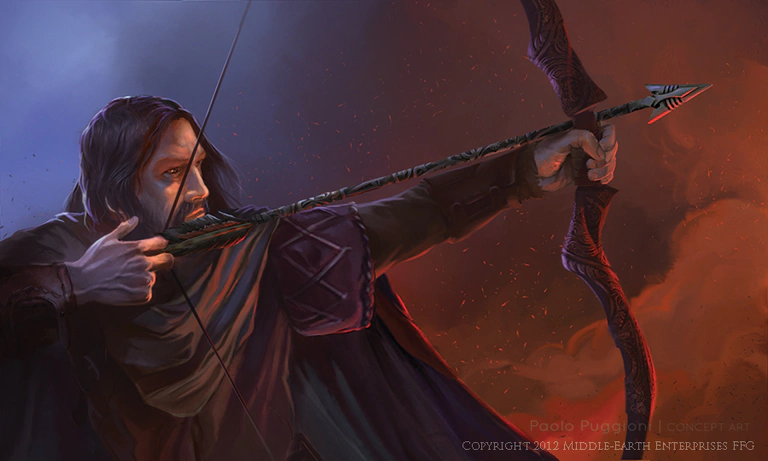
Amidst the havoc, Bard the Bowman, heir to the throne of Dale, did his best to rally the townsmen to repel the dragon's assault, but their arrows did little against the dragon's armor. Then, Bard, having been informed by a thrush of Smaug's secret weakness, fired a Black Arrow into the vulnerable spot of the dragon's belly. Roaring in fury and pain, Smaug fell from the sky and plummeted into the flaming ruins of Lake-town. His death marked the end of the great dragons in Middle-earth.
Size
Smaug's actual size is unknown as it is never explicitly mentioned in The Hobbit, and illustrations by Tolkien, Alan Lee, and John Howe greatly vary in size in each portrait while the size of the Front Gate of the Dwarven kingdom in illustrations seems similar to what was depicted in the live action films. In The Atlas of Middle-earth by Karen Wynn Fonstad, Smaug is said to be about 18 meters (59 feet) in length, but this is to be considered non-canonical. Other sources, for the film, name Smaug as being 143 meters (470 ft) in length, which is greater than two jumbo jets.
Tolkien gives some indication later of the dragon's size in relation to the depiction of Bilbo as portrayed in the original illustration for The Hobbit in Letter 27, which was published in The Letters of J. R. R. Tolkien:
One of few other descriptions available by Tolkien is that Fang, with a 5 feet tall door and a passage wide enough for three people to walk together, was too small for the dragon even when he was young, and he considered it a "tiny hole which he should have sealed up" and could only put the tip of his jaw into the passage when he was grown and breathed out fire and vapor not from his jaw but from his nostrils instead. Additionally, the Black Arrow launched by Bard completely disappeared into the dragon's body, and the corpse of Smaug severely destroyed Lake-town when it fell. These, along with descriptions of dragons by Tolkien to possess elongated, serpentine bodies, indicate that Smaug in book could have been much larger than the above mentioned estimation by Karen Wynn Fonstad.
It is unclear whether Smaug, the largest specimen in the Third Age, would compete in mightiness to his ancestors of average size in the First Age, though he was clearly smaller than Ancalagon, the largest known dragon to have existed.
Abilities
Being a fully-grown dragon, Smaug was both massive and powerful, possessing physical strength capable of crushing stone with ease, as seen by his attack on the Lonely Mountain. He was able to fly thanks to his large wings, and had the ability to breathe streams of searing hot flame and vapour from his mouth and nostrils. Some comments in The Hobbit imply that his entire body was imbued with fire, as he was seen to glow in the darkness of the Lonely Mountain's depths, and his usual paths were said to have been "smoothed and slimed" (i.e. melted) by his passage.

Like many dragons of Middle-earth, Smaug's monstrous appearance also belied keen senses and a dangerously sharp mind. He had an encyclopaedic knowledge of his treasure hoard, immediately registering the theft of a single cup after Bilbo made his first visit to his lair. When the hobbit returned a second time, Smaug was already expecting him by feigning sleep, and immediately declared that he could sense the thief even if he could not see him. Although Bilbo was clever enough not to fall for Smaug's attempts to trick him into revealing his exact position, the dragon used the resulting conversation to plant doubts in Bilbo's mind, correctly guessing that the "burglar" had allied himself with the Dwarves and the men of Lake-town and asking if Bilbo had ever considered the logistical difficulties of getting his share of Smaug's treasure back to his home. Despite his size, Smaug is shown to be agile and quick, able to leap over objects with ease, and he can dive at very high speeds with little effort.
Defensively, Smaug's reddish-gold scales rendered him impervious to nearly all weapons, but his underbelly was relatively soft and vulnerable. To compensate for this, Smaug took to sleeping upon the gathered treasure of the Lonely Mountain, allowing bits of gold and jewels to embed themselves in his body. This "diamond waistcoat" was intended to cover his only physical weak spot, but when Bilbo Baggins confronted the dragon in his lair, he discovered a bare patch on the left side of his chest. Bard was told this by an ancient thrush that overheard Bilbo relating this information to the Dwarves, enabling him to defeat Smaug by shooting his black arrow into the bare patch.
Appearance and Personality
Smaug is described as a red-golden dragon, with bat-like wings and a huge tail. His jaws and nostrils were always emitting smoke, but the fires inside him burned low when he was at rest. His red-golden scales were tough enough to deflect most blades, but these only covered his upper hide. Knowing that his soft underbelly was his weakness, he had spent many years sleeping on his hoard, causing a crust of gold and jewels to stick to his belly. However, unbeknownst to him, his armor was still imperfect; there remained a spot on his left breast "as bare as a snail out of its shell."
Smaug is shown to be, cunning, violent, cruel, arrogant, and greedy, possessing an unquenchable desire for gold. His most distinguishing characteristic (aside from his greed) is his arrogance, as Smaug proudly boasts of his superiority and impregnability to Bilbo during their encounter. However, this proves to be his downfall, as he unwittingly reveals the weak spot in his chest to Bilbo when showing the Hobbit how he had willfully coated his underbelly in treasure to protect it.
Though he was a clever beast, his second weakness seems to be his rage in itself. While destroying Lake-Town, he swooped down straight through an arrow-storm, "reckless in his rage, taking no heed to turn his scaly sides towards his foes, seeking only to set their town ablaze." In his fury and revelry, Smaug neglected to guard himself, exposing his belly and giving Bard the chance he needed to slay him.
Smaug seems primarily motivated by personal greed rather than a desire to do evil, and does not seem to serve any allegiance other than his own. While he does ruthlessly destroy Dale and lays waste to the Dwarves of the Lonely Mountain during his attack on the Lonely Mountain, once he has assumed dominion of the region he seems content to allow the rest of Middle-earth to go about its business, so long as he or his treasure remains undisturbed; although this could be because he feels that the people living in the region have nothing he wants. Highly intelligent, Smaug appears to possess a rather sardonic sense of humor, darkly mocking Bilbo while they converse within the Lonely Mountain's treasure chamber. Smaug seems to despise the Dwarves, considering them to be weak and pathetic creatures far beneath him, making unfavorable comments about Thrór and showing no remorse over his slaughter of their kind and claiming of their kingdom. While conversing with Bilbo, Smaug is also able to quickly surmise the reason for Bilbo's presence in Erebor, and also correctly deduces that the Dwarves received aid from the men of Esgaroth in reaching the mountain.
Origin
It is possible, but not verified by Tolkien, that Smaug was born in the Third Age and was from Withered Heath, like other dragons in those days, for several reasons:
Gandalf noted that Smaug was not fully grown at the fall of Erebor and Dale and the dragon wouldn't have been able to creep into the secret pass even before his attack on the two cities.
Only two dragons, either any of its kind or winged, survived the War of Wrath although this doesn't mean that all of remaining dragons of that time joined the war.
Smaug's first appearance at Erebor was 2,770 years after the start of the Third Age and he resided in the mountain for 171 years, a time span being somewhat similar to Glaurung' s case where he took about 195 years to mature; Glaurung was "yet young and scarce half-grown" in FA 260 while his presumed birth was in FA 155.
If Smaug was born in the First Age, he should have been at least 6,212 years old at his death and he wouldn't have been "young and tender" at the falls of the two cities as he said he was.
Smaug had only mentioned Men and Dwarves of the two cities in the conversation, and it seems inappropriate to consider that he was suddenly referring to those in the First or Second Ages.
The Lord of the Rings film trilogy
Although Smaug makes no appearance in Peter Jackson's The Lord of the Rings film trilogy, he is indirectly mentioned by Gandalf during his conversation with Frodo near the beginning of The Fellowship of the Ring. When Frodo jokingly tells Gandalf that the other hobbits have officially labelled him a "disturber of the peace", Gandalf responds with "if you're referring to the incident with the dragon, I was barely involved".
Additionally, when Gandalf visits Bag End, he picks up the old map of the Lonely Mountain from Bilbo's desk, which has an illustration of Smaug on it.
The Hobbit film trilogy

I am fire, I am... Death!
Smaug is voiced and interpreted with performance capture by Benedict Cumberbatch in Peter Jackson's three part adaptation of The Hobbit. Smaug is presented with a long, serpentine neck; a crest of spurs on his head; a crocodilian facial shape; a compact torso with a streamlined shape; spines and spikes along his back and the back of his neck; stocky hind-legs; a very long tail; mostly dark-red scales which turn dull-golden on his underside; and gleaming, orange-yellow eyes coloured like fire, with slit-pupils which possess an intricate, keyhole-like shape. He has a deep, resonant voice with an underlying growl.
He appears in the prologue of the first film, The Hobbit: An Unexpected Journey, described as a "fire-drake from the north" before taking residence in the Lonely Mountain. Only small parts of him are glimpsed throughout the film: his legs, tail, a small part of his head, and his wings as he flies over Dale, and his eye when he is sleeping in his mound of treasure, in the final scene. In addition, he is a topic of discussion amongst the White Council as Gandalf cites his reason to support Thorin Oakenshield's quest.

In the second film, The Hobbit: The Desolation of Smaug, Thorin and Company arrive at the Lonely Mountain, entering through the secret door, and send their burglar Bilbo Baggins to find the Arkenstone. The hobbit unwittingly causes a landslide amongst the mountainous pile of treasures, uncovering the dragon. Smaug stirs from his sleep, suspicious that someone is in the chamber with him. Although Bilbo is forced to use his Ring to keep out of sight from the dragon, Smaug is immediately aware of his presence by his scent (whilst the smell of hobbit is unknown to him). He begins to search for Bilbo, beckoning him to come out from where he is hiding and when Smaug gets too close, the Hobbit is overcome with fear and attempts to run, only to alert the dragon, who chases after him through the chamber. Bilbo evades him and hides behind a massive pillar, still under the cloak of the ring. Smaug continues his search and claims that he is aware of the Ring in Bilbo's possession and that he sensed that Bilbo has something "made of gold, but far more precious," which in turn forces the Hobbit to remove the Ring. Smaug is amused by Bilbo's knowledge of who he is, and begins his conversation with the Hobbit in order to deduce his origins.
During their conversation, Bilbo then tries to lie to Smaug by claiming that he is no more than a simple traveler who came to the mountain alone to see the dragon, as he didn't believe the tales about him. The dragon asks Bilbo if he thinks flattery will keep him alive, and asks who he is and where he comes from. Bilbo responds in riddles, claiming that he "came from under the hill and over hills and under hills his path had led", and through the air he was "he who walks unseen". Smaug hardly believes him but asks Bilbo what also did he claim to be and the Hobbit answered that he is the "luck-wearer", "riddle-maker", and "barrel-rider". The dragon then reveals that he knows that the Dwarves are outside of the mountain, although Bilbo (whose eyes are on the Arkenstone) tries to deny it, with Smaug not taking the bait. Soon, a cat-and-mouse banter begins with Smaug and Bilbo, as he makes unfavorable comments about Thrór and boasts about his armor and invincibility. Smaug then realizes that Thorin, Thrór's grandson, has sent Bilbo for the Arkenstone and reveals to him that he found out about Thorin's goal "some time ago", and says that it doesn't matter because the quest is ultimately futile, as he is aware that Sauron was preparing to openly declare himself once more.
Later on, Smaug tries to break Bilbo's friendship with Thorin by lying to him, claiming that the Dwarf is using him and finds his fate worth nothing, but the Hobbit refuses to believe him. Smaug is intrigued by his word and wants to know what reward Thorin is willing to give him if he succeeds in finding the Arkenstone, before stating that he will never give away any of treasure, not even a single coin. During the game, Smaug discerns the Hobbit's attempt at stealing the jewel and keeps Bilbo from catching the Arkenstone, boasting about his superiority. During the chase, Smaug shows Bilbo his underbelly, coated in gems, and the Hobbit catches a glimpse of a single missing scale. Smaug then spots Bilbo's eye on the jewel and claims that he is almost tempted to let him take it, only to let it consume Thorin to madness just like it did Thrór. At that point, the dragon ends the banter with Bilbo and attacks the hobbit. Bilbo uses his ring to escape and manages to get the Arkenstone while Smaug flies around in rage and unleashes a torrent of flames around the treasure chamber in an attempt to roast the Hobbit alive before he can escape.
When Smaug sees Thorin pointing his sword at Bilbo, asking if he found the Arkenstone, the dragon charges. The other Dwarves with Thorin appear to defend their friends, and Smaug charges after them, summoning his fire to attempt to burn them to death. However, the Dwarves manage to elude him, and Smaug begins to silently stalk the abandoned halls in search of the hidden Dwarves.
I am King under the Mountain!
Upon realizing the dragon is blocking their only path out of the mountain, the Dwarves hatch a desperate plan to lead Smaug to the Lonely Mountain's forges in hopes that they can trick him into breathing fire into the chamber and rekindling the smelting vats. Their plan works and they reveal themselves to Smaug, initiating a perilous game of cat-and-mouse through the halls of the mountain, doing everything in their power to encumber the pursuing dragon as they race towards the entrance to the Lonely Mountain. As Bilbo leads the dragon into the Gallery of the Kings, he is quickly overrun by Smaug, who deduces that Bilbo and the Dwarves were aided by the men of Lake-town, and leaves to destroy the town, and when Bilbo protests Smaug cruelly and gleefully tells him that now their deaths will be on their heads. As he is leaving, Thorin appears and taunts him, unveiling an enormous, freshly cast golden statue of a Dwarf, which distracts the greedy dragon long enough for the statue to melt into liquid gold and engulf him. However, just before Thorin thought he had drowned Smaug, Smaug survives the scalding gold and erupts from the molten pool, bellowing that he will show the Dwarves what revenge really is. He then breaks through the walls of the mountain, shakes off his gold coating, and takes flight toward Lake-town. The film ends with him uttering "I am Fire, I am.....Death!" as he soars towards the unsuspecting town, leaving Bilbo and the others dumbstruck at the horror they have unleashed.
In the opening of the third film, The Hobbit: The Battle of the Five Armies, Smaug, after reaching Lake-town, unleashes torrents of fire to destroy the town for their part in aiding the Dwarves. Bard, having escaped imprisonment by the Master of Lake-town, climbs atop the bell tower and begins firing arrows at the dragon, though each attempt fails, harmlessly bouncing off Smaug's armor. Eventually, Bain, Bard's son, arrives to aid his father with a Black Arrow. Unfortunately, as Smaug flies over, he claws at the tower, toppling most of it. With the bell tower now half-destroyed, Bard is forced to make a makeshift crossbow using a rope that held the bell, some pieces of broken wood, and Bain as a stand. Smaug lands, and looks towards Bard, sneering at his attempts to stop him. Ignoring him, Bard notches the arrow, while Smaug charges him and his son. Bard looses his arrow, which hits Smaug straight in the chest, the shaft sinking into the spot with the missing scale. The dragon stumbles, knocking Bard and Bain off their perch, before flying back up. Clawing and biting at the sky, his internal glow fades as he dies in mid-air. Smaug's body, upon falling to the water, lands on Lake-town's corrupt master, killing him.
Even after his death, Smaug's influence is felt throughout the movie. Aside from the damage he inflicted on Lake-town, driving the residents to try and stay in Dale, as Thorin falls under the influence of the dragon sickness, Bilbo begins to hear him speak in Smaug's voice, and Thorin experiences a hallucination of Smaug while walking on the golden floor that they created while trying to 'drown' the dragon.
Smaug was considered the highlight of the second film of the series. with several critics hailing it as cinema's greatest dragon incarnation. Universal praise was also given to the visual effects company Wētā Digital and the vocal and motion-capture performance of Cumberbatch for bringing a fully realized personality to Smaug.
The Extended Edition of The Desolation of Smaug confirms Gandalf the Grey's fears of Smaug being in league with Sauron as Thráin reveals in Dol Guldur. Should the Dragon have survived its attack upon Lake-town, then the Dark Lord would have used him to devastating effect against the Free Peoples in the North.
Personality
While his personality is more or less the same as the book, in the films, Smaug is considerably more malicious, cruel and borderline unhinged. He takes much more pleasure in psychologically tormenting Bilbo, making suggestions that Thorin was just using him, that flattery wouldn't keep him alive, choosing to spare Bilbo so that he can watch Lake-town burn and showing pleasure that Bilbo cares about the people of Lake-town, telling him that their deaths would be on his head, and sarcastically asking him how he would like to die. Smaug shows himself to be intensely sadistic, contemplating out loud that he would allow Bilbo Baggins to bring the Arkenstone to Thorin if only to watch the stone wreak havoc on Thorin's mind the way it did Thrór's, and his voice took on a manic tone when he was particularly excited or riled up. During his attack on Lake-town, Smaug goes out of his way to mock and sneer at Bard and Bain just before he intends to kill them. Smaug is aware of the return of Sauron, and was apparently intent on joining forces with him (although there was some amount of confusion as to whether the dragon's motives for an alliance with Sauron were).
Though intrigued like in the book when encountering a hobbit for the first time, Smaug despised Dwarves intensely, considering them wretched and bottom-feeding creatures as he comments on how they'd be naturally urged to come after his treasure. Ironically, some of the unfavourable remarks Smaug made about them could be used to describe himself, showing off the self-contradictory aspect of his personality. Smaug seemed to hold a grudge towards Thorin in particular, possibly due to suspecting the dwarf-prince's greed or knowing about his royal claim on the Lonely Mountain and its treasure. Likewise, upon realizing the people of Lake-town had been in league with the Dwarves, Smaug displayed a mix of hatred, paranoia and contempt towards them, calling them "miserable", "snivelling cowards", and seething at the recollection of their ancestors' usage of black arrows against him.
Like his book counterpart, Smaug is extremely arrogant, and the mere implication that he may possess a weakness made him visibly angry; being insulted by Thorin was also quick to earn his anger. Smaug was supremely confident in his own powers, shown in his famous speech about how certain components of his body were weapons of destruction. He was utterly ruthless, completely capable of committing genocide either in pursuit of his goals, or more likely for the sheer horrific pleasure of it. Due to his overwhelming hubris, Smaug clearly suffers from a superiority complex, believing himself to be King under the Mountain on account of how he had destroyed the original kings. Smaug's obsession with gold and his own possession of it would be startling enough for Bilbo to realise later when Thorin started to show the same kind of sickness.
Size and appearance

In the film adaptations, Smaug dramatically increased in size. In the comments of "Made in the Makings", his size is mentioned to be "bigger than two jumbo jets" or "twice as long as and twice as wide as Boeing 747". In pre-publishing comments by Joe Letteri, the Oscar winning VFX supervisor from Wētā Digital, Smaug was said to be "twice as big as a Boeing 747", indicating each wing could be more than 60 to 70 meters in width. These indicate that Smaug in the movies ranged from 130 to 152 meters in length and from 120 to more than 140 meters in width.
Smaug was furthermore designed to be covered in dead and flaking skin like an old reptile, causing slight variations in his scales' colour, and facial scars from past battles - debatably the most noticeable scar in the finished film is one on the left side of his lower-jaw.
In original concepts, Smaug was supposed to be more menacing and wicked, more gigantic, and more serpentine than in the actual movie, and these changes were made to make his character more 'special' to create "a character than a monster". The same trait happened with Gollum as well.
Film continuity

In the prologue of the theatrical release of An Unexpected Journey, Smaug had six limbs (four legs and two wings), which was his initial design. His forelimbs were among the body-parts that were clearly glimpsed, being bulky in appearance and each ending in hand-like feet with five taloned fingers. It was changed for both subsequent films and also the first film's Extended Edition, where the dragon has four limbs (two hind legs, and two bat-like forelimbs which act as legs/arms for crawling and as his wings); each of Smaug's winged forelimbs possessed six digits in total; a thumb, two taloned fingers separated from the wing membrane, and three long phalanges joined together by a bat-like wing membrane to form his wings.
Additionally, several scene captures from the first film revealed that his scales were seen to be in blue coloring at the very end of the film for unknown reasons, although this could largely be because the filmmakers had yet to finalize Smaug's design when the film was released or due to the dark lighting of Erebor's halls.
The film also deviates from the book in portraying Smaug's underbelly as being as heavily armored as the rest of him, rather than being artificially protected by a coat of gold and gems. The bare patch that Bilbo notices is a single missing scale instead, broken off during his attack on Dale, by one of the Black Arrows fired by Girion.
Unlike in the books, Smaug gives no mention to his tail or fiery breath during his speech to Bilbo, nor does he use either to smash the mountainside before he flies to Lake-town, although he does breathe fire during the battle with the dwarves, and his tail does cause some (seemingly unintentional) damage to structures around him during the battle in the forges.
J.R.R. Tolkien's The Hobbit (1967 short film)
In J.R.R. Tolkien's The Hobbit by Eugene Merril Deitch, Smaug's name was changed to be "Slag", "the ancient monster of the Earth". He was slain by Bilbo, Thorin's company, and "Princess Mika" (an invented character who was one of three survivors from Erebor and Esgaroth along with Thorin) by shooting a large arrow, with the heart-shaped Arkenstone serving as the arrowhead, from a ballista.
The Hobbit (1977 film)
In the 1977 animated film of The Hobbit by Rankin/Bass, Smaug was voiced by Richard Boone, and his head appears wolf-like. Unlike the book, the dragon-spell was absent from the movie and was replaced by light beams to try to find Bilbo.
Voice dubbing actors
- Portuguese (Brazil) (Television/DVD) Ricardo Schnetzer - Spanish (Latin America) Carlos Segundo - Spanish (Spain) Ivan Muelas - Italian (Italy) Luca Ward - Japanese (Japan) Ryuzaburo Otomo - Hungarian Peter Haas Vander - Czech Aleš Procházka - French Jérémie Covillault - German Sascha Rotermund - Polish (Poland) Jacek Mikołajczak
Sources
Adapted from the original article, under CC BY-SA 3.0.