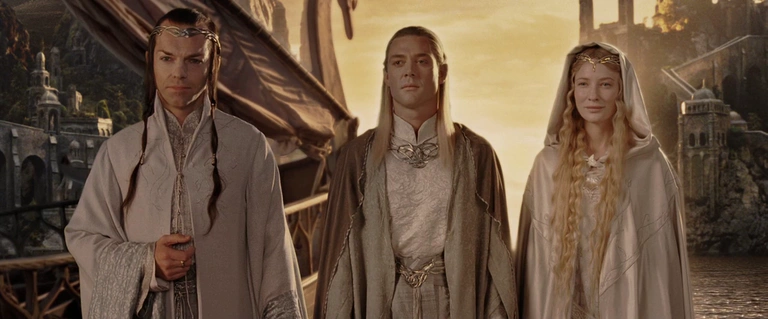
Group
Avari
The Avari were a branch of the Elves in Middle-earth, the group of Moriquendi…
The Avari were a branch of the Elves in Middle-earth, the group of Moriquendi ('Elves of Darkness') who never journeyed to Aman, and their descendants. They were also known as Avamanyar (Quenya for 'Those who would not go to Aman'), as opposed to the Amanyar, 'Those of Aman', and Úmanyar, 'Not of Aman'.
History
When Oromë found that Elves had awakened in Cuiviénen, he invited them to come with him to Valinor. All the Minyar and most of the Tatyar and Nelyar were persuaded and followed Oromë into the west on the Great Journey. The remainder of the Tatyar and Nelyar remained suspicious of the Lords of the west, seeing them only in their wrath, or they simply refused to depart from their own lands, and spread gradually throughout the wide lands of Middle-earth. They were after known in Quenya, the language of the Eldar that eventually reached Valinor, by the name Avari, meaning "the Unwilling", because they refused the summons.

Having never come to Valinor, the Avari remained wild folk, dwellers of forests. Little is known of them, as they do not appear in any of the tales, save some references to Avari creeping in the south of Beleriand in the First Age. Some of them merged with the Nandor and Sindar in Eriador and the Vale of Anduin.
In The War of the Jewels, names of six tribes of Avari in their own languages are given, all being cognates of the Quenya term Quendi (the Speakers): Kindi, Cuind, Hwenti, Windan, Kinn-lai, Penni. They are the only certain Avarin words ever mentioned in the published Middle-earth material. It is speculated however that Dorwinion was an Avarin land, with Winion carrying the meaning "wine".
The Annals of Aman, given in Morgoth's Ring, suggest that Orcs descended from Avarin Elves captured and corrupted by Melkor, in mockery and in his envy of the Eldar in particular. Tolkien suggests elsewhere that this notion was, at least, a belief the Eldar held about the Orcs' origin. The matter is not ultimately clarified.
Eöl, one of the Teleri, was called the 'Dark Elf' for how he shunned the daylight, preferring to stay within the dark woods of Nan Elmoth and walk at nighttime. He was not, in fact, of Avarin lineage, being related to Thingol.
In other versions
In older versions of the legendarium, the name Avari was originally that of the later Eldar, then meaning "those that departed".
In other, relatively late writings, a brief idea was that the Avari did not come from the three clans, but from two other clans, led by Nurwë and Morwë. This idea was later dropped. In the final conception, the Elves were divided into three tribes.
In adaptations
In The Lord of the Rings Online game, the Avari are found in the land of Near Harad, or "Shagâna" as it is called by the locals, living within its oases and forests. They speak not the name given to them by the Eldar, considering it an insult (as it is not covered by the game's license), and call themselves Tárthai ("Those Who Remained"). The particular branch encountered in Near Harad are known Avabár-kinta ("People Without Home"), or simply Kintai. They seek not to travel west either in life or after death, believing that the way there is forever closed to them, and have developed an elaborate system of beliefs and rituals regarding their fate after death, whether through fading or through violence in battle. The Wise who journey through those lands eventually reveal to some of the Kintai that some of what they believe is not entirely true.
Sources
Adapted from the original article, under CC BY-SA 3.0.