Thing
Orcrist
Elven sword from Gondolin, the mate of Glamdring
Orcrist (also called the Goblin-cleaver) was an Elven sword from Gondolin, the mate of Glamdring. Thousands of years later, it became the sword of Thorin II Oakenshield during the Quest of Erebor.
It was used by Thorin in The Hobbit, and was feared and called Biter by the Goblins.
History
During the First Age, Orcrist was forged alongside its "mate", Glamdring by Elf smiths, and might have been used by one of the Lords of the Gondolindrim in the Goblin Wars, becoming lost during the Fall of Gondolin. It was described to have "killed hundreds of goblins in its time, when the fair Elves of Gondolin hunted them in the hills or did battle before their walls".
Third Age
Orcrist was discovered with Glamdring centuries later. Thorin and Company made the discovery in the Trolls' lair, with Gandalf observing the high quality of the blades. Once in Rivendell, Elrond recognized Orcrist as one from Gondolin, and Thorin promised to honor the sword.
Thorin used Orcrist throughout the rest of the Quest of Erebor to slay Orcs in Goblin-town after the killing of the Great Goblin, but he lost it when he was captured by the Wood-elves of Mirkwood. Orcrist was confiscated and was not returned to him until after the Battle of Five Armies. Upon his death, Thranduil returned the blade and Orcrist was placed upon Thorin's tomb under the Lonely Mountain, and it "gleamed ever in the dark if foes approached".

In The Hobbit: The Desolation of Smaug, Orcrist is taken by Legolas when he and a group of Elves capture Thorin's company, and it is subsequently shown being wielded by Legolas when he fights Bolg and other Orcs in defense of Lake-town.
In The Hobbit: The Battle of the Five Armies, Legolas uses Orcrist to stay his father Thranduil's blade when intervening in a conflict between him and Tauriel, in Dale. He then draws Orcrist to battle Bolg once more, but ultimately sacrifices Orcrist to save Thorin's life, throwing it from afar, into the chest of the Orc who nearly killed Thorin, high up on the frozen waterfall. Thorin then retrieved the sword from the dead Orc's chest as it fell over the edge, and used it in the climactic battle with Azog on the Celduin near Ravenhill. Orcrist easily held up to Azog's much larger mace as well as his sword. Thorin dealt the mortal blow to Azog, by allowing Azog to pierce his chest, bringing Azog close enough to impale his heart. With Azog on his back, Thorin presses Orcrist deep enough that it splits the ice beneath Azog's body. As in the novel, Orcrist is shown in the extended edition of the film to be buried with Thorin. While it is an Elvish sword, it does not appear to glow blue (or glow at all, for that matter) when Thorin is in the presence of Orcs in the film. This reflects the fact that Glamdring did not glow in the films as well.
The design and make

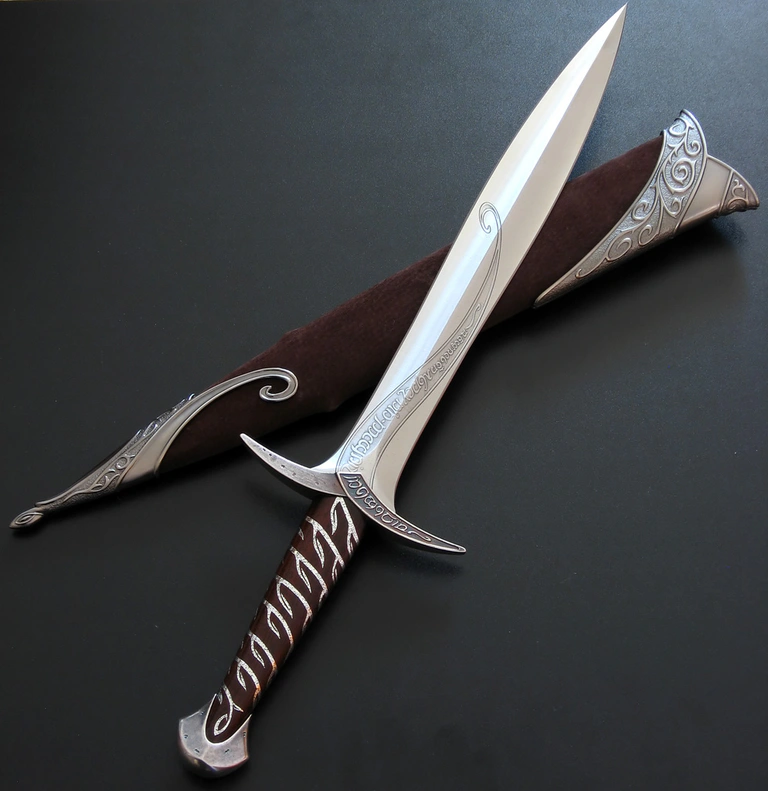
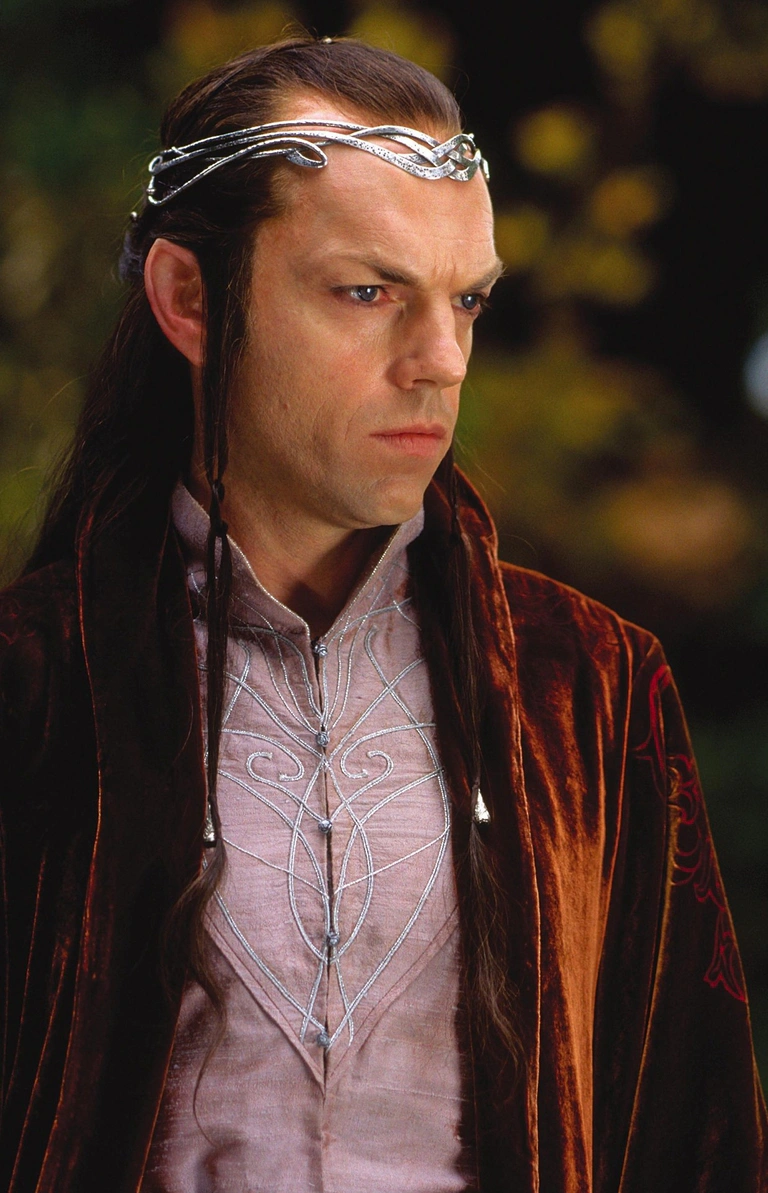
In Peter Jackson's The Hobbit film trilogy, Orcrist appears more similar in shape to Sting. Its appearance - a single-edged weapon with a somewhat curved pommel - is also somewhat reminiscent of Hadhafang, the blade wielded by both Arwen and Elrond in The Lord of the Rings film trilogy. The main difference is that Hadhafang has a curved blade, whereas Orcrist's is straighter. It is also shown to be very powerful, as it is able to knock back a vicious swing from the Great Goblin with ease.
The grip is made of a large tooth capped in a metal pommel. The pommel also displays Ecthelion's herald giving speculation that Orcrist was his sword. The runes running along the blade have been translated to be NAGOL E-LŶG or "Tooth of-Snake [or Dragon]". In the movie The Hobbit: An Unexpected Journey, the sword's designers went with a single-edged blade due to its name Goblin Cleaver. However, an early scene of old Bilbo shows replicas of Orcrist and Glamdring in the background, where the Orcrist replica does have a curve on the flat edge.
Orcrist's spine was ultimately kept fairly straight, meaning it should function well as a thrusting weapon. Its blade is convex towards the point akin to a Hellenic makhaira - making it forward-heavy and putting much more momentum into slashing attacks, as befits a Goblin Cleaver, and indeed giving it reminiscent of a war axe. Thus, ironically, the movie version Orcrist is a versatile weapon well-suited to Dwarven tastes despite its Elven origin.
The movie version has runes engraved in the Cirth script. Wētā Workshop designer Richard Taylor stated that this was done with the intention that Elves put magic inscriptions on the blade to strengthen it. This idea is repeated with various other weapons, such as Andúril. In The Hobbit trilogy, Gandalf is able to recognize it as a sword of Gondolin, but Elrond identifies it by name. The design of the blade is also different to the Elvish curved swords regularly seen, likely because the blade was made in the First Age, where sword design was different.
Sources
Adapted from the original article, under CC BY-SA 3.0.