Place
Gondolin
Gondolin was a hidden city of the Elves located approximately in the middle of…
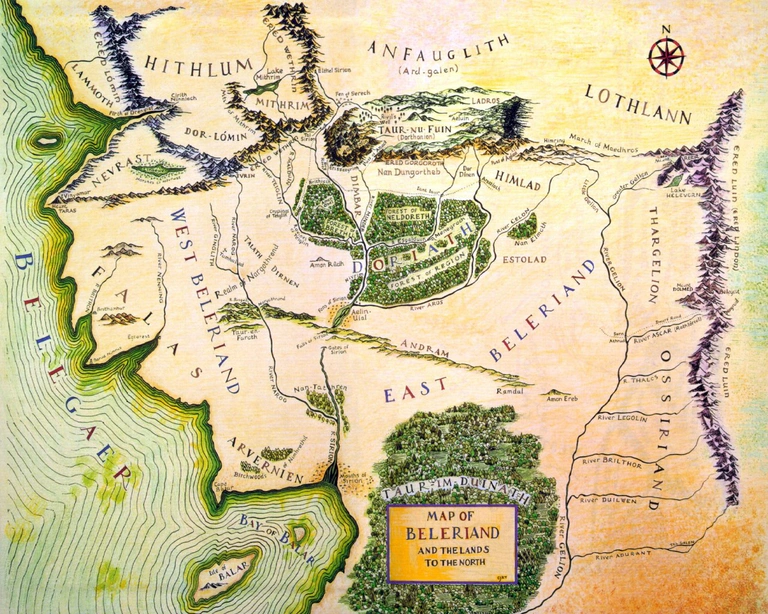
Gondolin was a hidden city of the Elves located approximately in the middle of the land of Beleriand in Middle-earth. It was founded by Turgon the Wise, a Ñoldorin king in the late First Age. It endured the longest of all the Ñoldorin kingdoms in exile, lasting nearly four centuries during the Years of the Sun.
Its people were the Gondolindrim.
History
As recounted in The Silmarillion, the Vala Ulmo, Lord of Waters, revealed the location of the Vale of Tumladen to the Noldorin Lord Turgon in a dream around the year FA 50. Under this divine guidance, Turgon travelled from his kingdom in Nevrast and found the vale in FA 53. Within the Echoriad just west of Dorthonion, and east of the river Sirion, lay a round level plain with sheer walls on all sides, and a ravine and tunnel leading out to the southwest known as the Hidden Way. In the middle of the vale there was a steep hill which was called Amon Gwared. There Turgon decided to found a great city that would be protected by the mountains and hidden from the Dark Lord Morgoth.

For nearly seventy-five years, Turgon and his people built Gondolin in secret. After it was completed in FA 116, he took with him to dwell in the hidden city his entire people in Nevrast — almost a third of the Ñoldor — as well as nearly three quarters of the northern Sindar. It was forbidden to leave Gondolin, but Turgon sent forth messengers including Voronwë to seek the Valar's aid in the wars against Morgoth, to no avail. Later in the Nírnaeth Arnoediad, Turgon led his army to the aid of his brother Fingon, and escaped the ensuing defeat with his army thanks to the sacrifice of Húrin and Huor.

Years later, Huor's son Tuor came to Gondolin with a warning from Ulmo: to depart before the city was destroyed. Feeling secure behind his city's strong walls, Turgon ignored the warning. The city stood for nearly 400 years until it was betrayed to Morgoth by Maeglin, Turgon's nephew, and sacked shortly thereafter by the Dark Lord's forces. Gondolin was described as this - "Now the streets of Gondolin were paved with stone and wide, kerbed with marble, and fair houses and courts amid gardens of bright flowers were set about the ways, and many towers of great slenderness and beauty builded of white marble and carved most marvelously rose to the heaven. Squares there were lit with fountains and the home of birds that sang amid the branches of their aged trees, but of all these the greatest was that place where stood the King's palace, and the tower thereof was the loftiest in the city, and the fountains that played before the doors shot twenty fathoms and seven in the air and fell in a singing rain of crystal; therein did the sun glitter splendidly by day, and the moon most magically shimmered by night. The birds that dwelt there were of the whiteness of snow and their voices sweeter than a lullaby of music." In accounts given in The Book of Lost Tales Part Two, inner features of the city such as the Road of Roses and Arch of Inwë are described by Tolkien.The Hidden Way to the city was protected by the Seven Gates, all constantly guarded: the first of wood, then stone, Bronze, Iron, Silver, Gold, and Steel.

In other versions
Gondobar am I called and Gondothlimbar, City of Stone and City of the Dwellers in Stone; Gondolin the Stone of Song and Gwarestrin am I named, the Tower of the Guard, Gar Thurion or the Secret Place.
Gondolin was known as the "City of Seven Names". Its Gnomish names were: Furthermore, in the city was once invented and used a runic alphabet known as Gondolinic Runes.
• Gondobar ("Stone House")
• Gondothlimbar ("House of the Stone Folk")
• Gwarestrin ("Tower of Guard")
• Gar Thurion ("Secret Place")
• Loth ("Flower")
• Lothengriol ("Plain Flower-Blossom", "Lily of the Valley")
Sources
Adapted from the original article, under CC BY-SA 3.0.