Group
Hill-men
The Hill-men were a group of indigenous Men from whom came an evil lord who…
The Hill-men were a group of indigenous Men from whom came an evil lord who seized power in Rhudaur in the Third Age. They lived in small tribes disparately across northern Middle-earth in the Third Age.
Origins
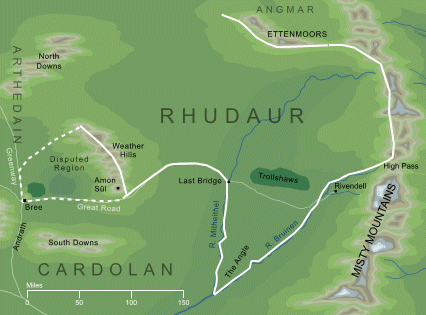
Almost nothing can be said about the origin of the Hill-men, except that they were Men and that they probably lived in or near Rhudaur.
It is possible that they were Pre-Númenóreans related to the Dunlendings and the Bree-men whose ancestors had lived in the valleys of the White Mountains and moved to the southern valleys of the Misty Mountains and then as far north as the Barrow-downs during the Dark Years.
It is also possible that they were Men of evil kinds who were not related to the Edain who were hostile to the Dúnedain. They may have been descendants of Easterlings who fled over the Blue Mountains back to the east after the War of Wrath at the end of the First Age or descendants of Easterlings who had not crossed over the Blue Mountains into Beleriand.
Third Age
It is possible that the Hill-men lived in the Ettenmoors or in the western Misty Mountains near the Angle at the time of King Argeleb I of Arthedain. It was during this time that an evil lord of the Hill-men made a secret alliance with the Witch-king of Angmar, who ruled the Men of Carn Dûm, and seized control of Rhudaur since there were few Dúnedain. The Hill-men under this lord were "workers of sorcery" who fortified the hills with dark structures.
In the year 1409, a great army came from Angmar and invaded Cardolan, burning the Tower of Amon Sûl, defeated the Dúnedain and killed King Arveleg I of Arthedain. Afterwards, some Men of Angmar who were "much given to sorcery" occupied Rhudaur and the Dúnedain of Rhudaur were killed or fled to the west.
The fate of the Hill-men is not known. They may have been among the "evil folk" that inhabited Fornost Erain after it was conquered by Angmar in the year 1974. The following year, the first Host of the West, consisting of Elves from Lindon, Men of Arnor, an expeditionary force from Gondor led by Eärnur, and Elves from Rivendell led by Glorfindel defeated the forces of Angmar so that no Man or Orc of Angmar "remained west of the Mountains". In the year 1977, the Men of Éothéod "drove away the remnants of the people of Angmar on the east side of the Mountains", leaving their ultimate fate untold. During the War of the Ring, Rhudaur and Angmar remained uninhabited.
The Lord of the Rings Online
In The Lord of the Rings Online, many tribes of Hill-men still roam the land in the late Third Age. These include the Corcur of the Trollshaws and the Misty Mountains (descendants of the Men of Rhudaur), the Créoth of the Lone-lands, and the Trév Duvardain of Angmar. A second tribe of Angmar, the Trév Gállorg, are shown to be friendly towards the Free Peoples of the World. These tribal names are original to the game and do not exist in the works of Tolkien.
The Battle for Middle-earth II: The Rise of the Witch-king
In EA's video game The Lord of the Rings: The Battle for Middle-earth II: The Rise of the Witch-king, the Men of Rhudaur are corrupted Hill-men who ended up serving Angmar and the Witch-king. Their warriors were Rhudaur Spearmen (who bear sharp spears), Rhudaur Axemen (who throw sharp axes), and Thrall Masters (who in gameplay can summon them, Gundabad Orcs, or Wolf Riders). Hwaldar the Chieftain of Rhudaur was their leader, and was disloyal to Arnor's royalty. He was defeated by the Men of Arnor once becoming hostile, but Angmar came to free him, as Morgomir, the Witch-king's second, recognized a valuable ally to control the forces of Men of Rhudaur. Angmar then destroyed two camps of Arnor and of the Dúnedain. King Argeleb I and his army were all slain, and Rhudaur was now of Angmar's dominion.

Sources
Adapted from the original article, under CC BY-SA 3.0.