Place
Rhudaur
Smallest of the kingdoms that originated from the break-up of Arnor in TA 861
History
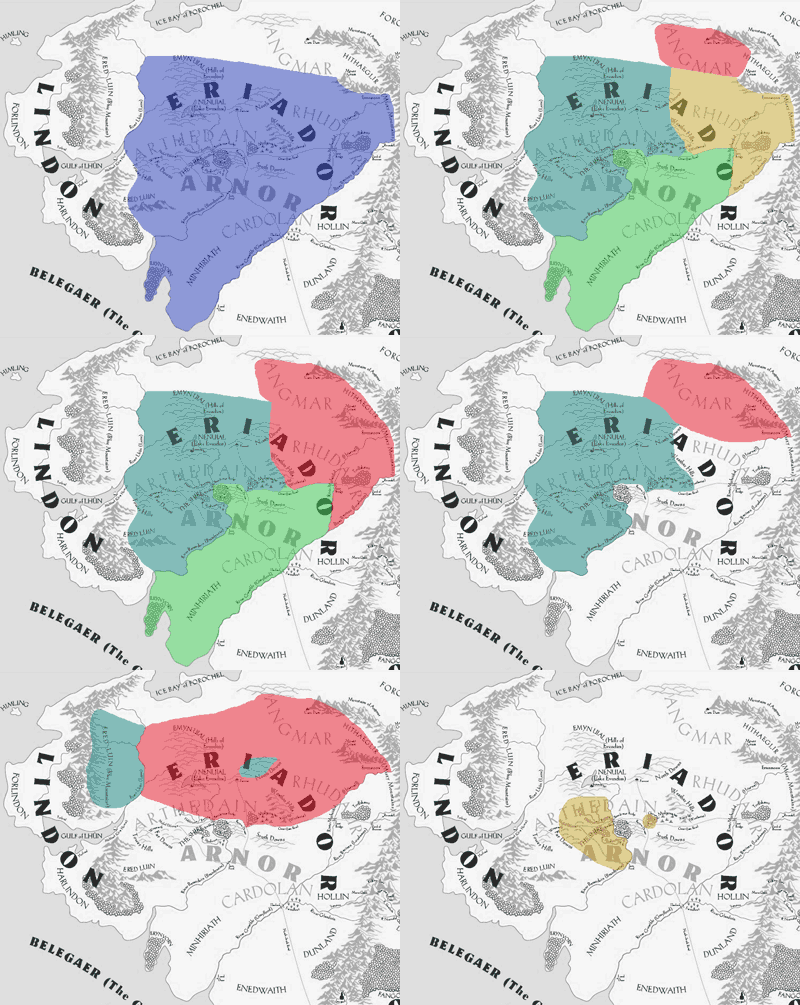
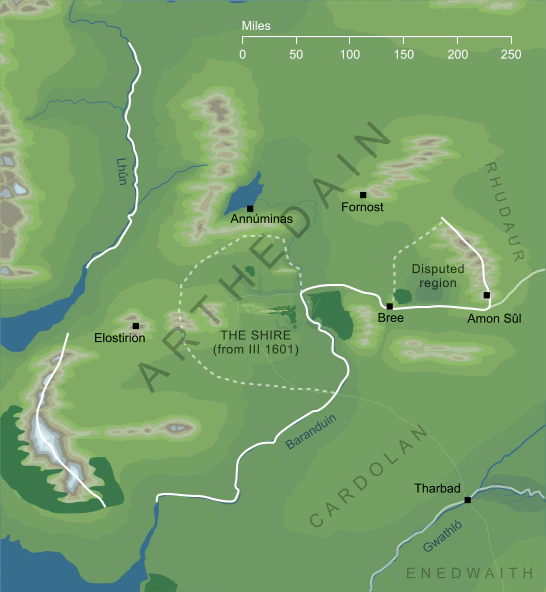
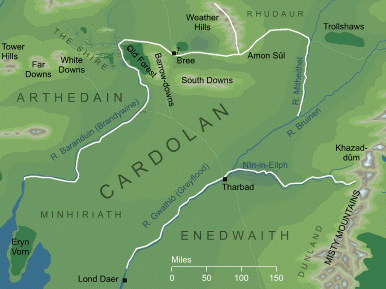
Rhudaur formed the eastern part of Arnor, and stretched from the Weather Hills with Weathertop to the River Bruinen. It shared a long border with Cardolan along the East-West Road, and with Arthedain along the line of the Weather Hills.
The land between the rivers Hoarwell and Loudwater was also considered part of Rhudaur. It was called the Angle, and it is here that the first Stoor Hobbits came into Eriador around TA 1150. However, due to the increasing hostility of Angmar these Stoors fled the region around TA 1356, with some of them moving west, and others moving back to Wilderland.

From the start of its existence, Rhudaur was unfriendly towards the two other successor states, and took part in a bitter conflict with Arthedain over the Tower of Amon Sûl and the palantír associated with the tower.
The House of Isildur failed first in Rhudaur, and the last Kings were not of Númenórean blood, but were Hill-men in service of Angmar. Under their rule the land became a vassal of Angmar (after TA 1349) and thus enemies of Cardolan and Arthedain.
Angmar annexed and terminated the kingdom in TA 1409. The last Dúnedain fled around this time and the remaining population of Hill-men died out at some point after this.
There is evidence that after the fall of Angmar at the Battle of Fornost, the Angle became home to the remainder of the Dúnedain, and the Rangers of the North established several villages there, where their people lived until the resurrection of the northern Kingdom under King Elessar at the end of the Third Age.
Middle-earth Role Playing
The structure and details of Rhudaur are significantly fleshed out in the Middle-earth Role Playing game:

The Haeranedain (S."Far Wandering Edain") were Rhudaurians of Númenórean descent, most were actually mix-blooded Tergil. Most Rhudaurian Dúnedain belonged to one of seven greater Noble Houses of Hiri, House Amrothar, House Eldanar, House Enedil, House Melosse, House Mithlad, House Rhudainor and House Rómentir.
The Rhudaurians (S."Rhudaurim") were the inhabitants of the fallen Kingdom of Rhudaur, in the closer sense those of Númenórean blood, the Haeranedain, in a wider sense all those Eriadorian tribes living inside the borders of Rhudaur including:
The Haeranedain were a bit smaller and darker than the high Dúnedain, although 6 ft for men was not uncommon.
In daily life most had adapted clothes much similar to those of the indigenous Hillmen, the Kailth, a skirt or kilt, and the Kullodoo.
• Hill-men of the Trollshaws and Coldfells
• Vulseggi or "Northrons" of the Egladil
• Dunmen of the southern borderlands to Eregion and Cardolan
• Forodrim of the Northern marches
The Battle for Middle-earth II
Rhudaur appears in the expansion The Rise of the Witch-king to the game The Lord of the Rings: The Battle for Middle-earth II by Electronic Arts.

The Hobbit film trilogy
Rhudaur appears briefly in Peter Jackson's The Hobbit: The Desolation of Smaug (2013) as the location of the High Fells, where, in the film's continuity, the Nazgûl were buried following their defeat by the Men of Arnor.

Sources
Adapted from the original article, under CC BY-SA 3.0.