Creature
Barrow-wights
Types of Undead-like beings made up of dead bones animated by evil spirits
The Barrow-wights were types of Undead-like beings made up of dead bones animated by evil spirits. They dwelt in dark places of Eriador such as the Barrow-downs and were similar in disposition to Wraiths.

Description
The Barrow-wights appeared as dark shadowy figures with a pale, icy light that gleamed from what appeared to be their luminous and cold eyes. Their voices were deep, hollow, and cold; their bony fingers had an icy touch like a deadly grip. Victims under a Barrow-wight's spell would lose their will; in this way the Barrow-wights drew the living into the tombs of the downs. Some, if not all, victims were laid on a stone altar and bound in chains of gold, to then be draped in pale cloth and jewelry of ancient dead, and killed by a wight with a sacrificial sword.
They were also known for carrying rattling gold-rings on their bony fingers.

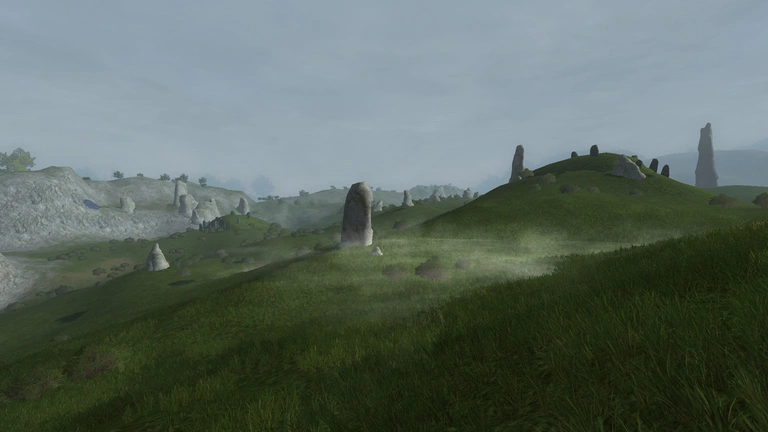
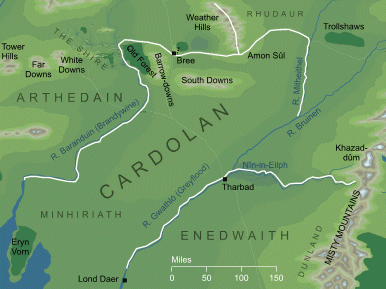
East of the Brandywine River beyond the Old Forest were the Barrow-downs, the most ancient burial ground of Men in Middle-earth. There were no trees nor water there, but only grass and turf covering dome-shaped hills crowned with monoliths and great rings of white stone. These hills were the burial mounds that were made in the First Age for the ancestors of the Edain, and later in Second and Third Ages for the Kings of Men.
In the darkness, wights were powerful spirits, resisted only by strong incantations such as Tom Bombadil's song. Dependent for many centuries on the dark security of burial vaults, they feared the sunlight, and would be diminished in exposure to it.
History
The Barrow-wights were possessed by evil spirits whose true nature is untold, whether they were Úmaiar, spirits of Orcs, fallen Avari, or evil Men.
In roughly the year 1409 of the Third Age, after the Dúnedain of Cardolan succumbed to the ravages of the Great Plague, these evil spirits were sent to the Barrow-downs by the Witch-king of Angmar in order to keep the Dúnedain from resettling the region. A few of these evil spirits haunted the cairn of the last prince of Cardolan. The spirits stirred the dead bones in the mounds and haunted them.
Sometime afterwards, the Barrow-wights became known to Elrond and other Elves, who knew them by many names such as evil spirits. They also became known to Hobbits, who referred to them as Barrow-dwellers in poetry.
According to Hobbit verse, Tom Bombadil escaped a Barrow-wight on some occasion, using his enchanting incantations.
During the War of the Ring in the year 3018, the Nazgûl entered Cardolan around September 24. Their chief, the Witch-king, moved to Andrath and visited the Barrow-downs, where he stayed for three days in order to rouse the Barrow-wights, empowering them in order to trap the Ring-bearer. The Nazgûl left on September 27.
On September 28, Frodo Baggins and his companions, Samwise Gamgee, Meriadoc Brandybuck, and Peregrin Took, while passing through the Barrow-downs, were captured by the spells of the Barrow-wights and trapped in what was believed to be the cairn of the last prince of Cardolan.

There they were almost slain by a wight; three of the Hobbits had been lain in a barrow filled with a strange green light and were dressed in white robes and wore jewels and gold and had a sword across their necks. The wight had finished an incantation, and was preparing to finish them off when Frodo summoned up the courage to slice off its hand; he then called upon Tom Bombadil when the wight extinguished the dim light in the cavern. Bombadil performed a song in the barrow and, through the rare power of his singing, caused the wight to flee with a shriek; he then gave the hobbits swords and spread out the gold and treasures from the barrow on the grass, so that the barrow's spell was broken and no wight could make habitat there.
In other versions
Due to his inspiration from the Hrómundar saga Gripssonar, during the writing of The Lord of the Rings J.R.R. Tolkien at first saw a link between the Wights and the Nazgûl, initially describing the Black Riders as "horsed Wights", but the suggestion that they were the same kind of creatures was dropped in the published work.

In other writings
The character Tídwald, appearing in J.R.R. Tolkien's poem The Homecoming of Beorhtnoth Beorhthelm's Son, accuses Torhthelm of fancying "barrow-wights and bogeys".
Inspiration
The concept of a burial mound housing evil spirits was not a new one created by Tolkien. The Barrow-wights themselves resemble a creature in Germanic Mythology known in Norse as Draugar (singular Draugr).

Another likely related creature from Germanic and Slavic folklore was the Mahr (also called an Alp), a vampire-like creature said to rise from its barrow after dark to plague the sleeping and drink their blood. Their chief vulnerability was exposure to sunlight, like the Barrow-wights of Tolkien's legendarium.
In adaptations
Many works of fantasy fiction, role-playing games and computer and video games use the term wight as the name of spectral creatures very similar to Tolkien's Barrow-wights: Dungeons & Dragons has created a monster called "Wight" and the terminology is also exemplified in the wights of A Song of Ice and Fire series.
The Lord of the Rings: The Rings of Power
Barrow-wights are featured in the middle of Season Two fighting against elves attempting to travel through the Barrow-downs. In the portrayal, the Barrow-wights are shown as decaying, tall skeletal undead using chains to pull victims to them. They have the ability to regenerate, unless weapons from their barrows are used against them.
In games
The Wight Lord was a boss in the 2003 video game, The Hobbit: The Prelude to The Lord of the Rings. He appeared in the "Flies and Spiders" level. His difficulty is due only to the constriction of the level; his minions and missiles only add to the chaos. Taking out the harder minions, and then wailing on him with Sting, all the while watching the health bubbles (and eating the lovely health mushrooms), proves the easiest way to defeat him.

In The Lord of the Rings Online, Barrow Wights are not just confined to the Barrow Downs, but have risen in many parts of Middle-earth mainly around the decaying ruins of Arnor. Wights can be found haunting the darkest corners of Mirkwood to even the Elven ruins which dot Ered Luin. A clan of warriors in Dunland has even gone as far as trying to raise their own undead army. Crypt-wights are categorized among the creatures called the Dead, "designed to be reminiscent of the wights of the great Barrow-downs in Eriador".
In the Middle-earth Role Playing game, Wights inhabit the graves of Dúnedan nobles, taking their power from a buried lord. Gaming statistics are given for minor, lesser, and major Wights. The Barrow Wights are a type of greater Undead Beings; remnants haunting their own tombs. They draw energy from living beings, sacrificing their victims.
In The Lord of the Rings Trading Card Game, Decipher produced a card depicting a Barrow-wight even though the Barrow-wights did not appear in The Lord of the Rings films. While the Barrow-wights do not appear in the Peter Jackson trilogy, Gollum does sing a part their incantation as Frodo talks to him about being Sméagol, and his sad story.
In The Lord of the Rings Roleplaying Adventure Game, Wights are one of the three types of ghosts. Wights refer to cursed beings, who remain "bound to the will and goals of the one who cursed them" in their after-life. Unlike wraiths and phantoms, wights can possess the remains of other dead people. Barrow-wights are corpses of Men animated by evil spirits.
In The Lord of the Rings: War in the North, Eradan, Andriel, and Farin encounter Barrow-wights during their trek through the Barrow-downs. The boss battle of the level is the Barrow-wight Lord.
J.R.R. Tolkien's The Lord of the Rings, Volume 1 SNES 1994
The Lord of the Rings: The Fellowship of the Ring (video game), 2002
The Hobbit: The Prelude to The Lord of the Rings, 2003 - "Wight Lord" (Spiders & Flies level boss)
The Lord of the Rings: War of the Ring, 2003
Middle-earth Strategy Battle Game
The Lord of the Rings: The Battle for Middle-earth II, 2006
The Lord of the Rings: The Battle for Middle-earth II: The Rise of the Witch-king, 2006
Karsh, a fictional Wraith-hero from Cardolan who is portrayed identically in form to the game's Barrow-wights
The Lord of the Rings Online
Sambrog, a non-canon wight-boss
Skorgrim, a non-canon wight, formerly a Dwarf lord
The Lord of the Rings: War in the North, 2011
The Barrow-wight Lord, a non-canon wight-boss who takes control of Kilaran
LEGO The Lord of the Rings: The Video Game, 2012 (downloadable character)
LEGO The Hobbit: The Video Game, 2014 (unlockable character)
In Soviet TV
• Khraniteli, 1991
Sources
Adapted from the original article, under CC BY-SA 3.0.