Place
Glittering Caves
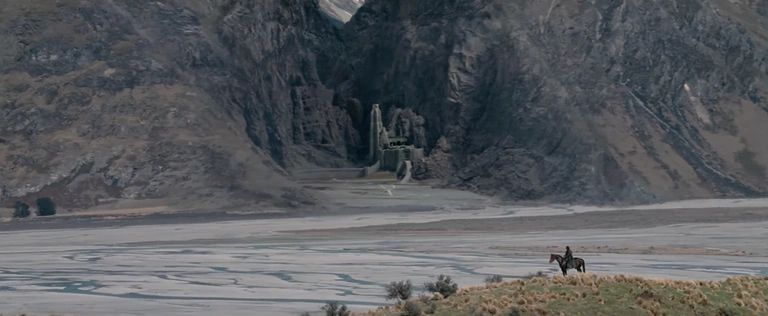
Cave system located behind the Deeping Wall of Helm's Deep

They are but hovels compared with the caverns I have seen here: immeasurable halls, filled with an everlasting music of water that tinkles into pools, as fair as Kheled-zâram in the starlight
The Glittering Caves, also known as Aglarond and Glæ̂mscrafu, was the cave system located behind the Deeping Wall of Helm's Deep.
Description
The Glittering Caves was an immense, beautiful, and ore-laden cave system that extended deep down into the White Mountains for many miles and consisted of many different paths, tunnels, and chambers. A small stream ran down through the narrows of Helm's Deep and into the caves and was its source of water.
History
Between the years 3320 and 3430 of the late Second Age, the Númenóreans of Gondor discovered Aglarond and built a fortress there.
After Calenardhon was given to the Rohirrim, the Glittering Caves became little used, explored, or known of outside Rohan, with the Rohirrim using them as a refuge during war and for the storage of provisions.
The War of the Ring and afterwards
During the War of the Ring, the Hornburg was the refuge of the Rohirrim in the Battle of the Hornburg after being driven back by Saruman's army.

After the war, Gimli the Dwarf, who had fought mightily in that battle, was allowed to settle a colony of Durin's Folk in the Caves, leading a host of Dwarves from Erebor and became the first Lord of the Glittering Caves. Gimli and Legolas had made a pact of friendship that when the War of the Ring ended, Gimli should walk in the deep woods of Fangorn and that Legolas should behold the jeweled splendour of the Glittering Caves. Gimli did so, and in time the Dwarves of the Glittering Caves restored and strengthened the Hornburg.
In other versions
In an early draft of "The Road to Isengard" chapter, Aglarond was originally referred to as the Caves of Helm's Deep.
While writing "The Palantír" chapter, Tolkien briefly thought of Aglarond as being the location of a Palantír, but rejected the idea. In that same draft, Tolkien referred to the caves as Aglarond, initially translating the name as the Caves of Splendour before changing it to mean the Glittering Caves.
In a later draft, Gimli refers to Aglarond as just the Caves.
Inspiration
In a letter to P. Rorke, S.J. on February 4 in 1971, J.R.R. Tolkien explained that Gimli's description of the Glittering Caves was directly inspired by his experience in 1940 visiting Cheddar Gorge, an extensive cave system in the southern English county of Somerset.
The Lord of the Rings: The Two Towers
In the second film of Peter Jackson's The Lord of the Rings trilogy in 2002, the appearance of the Glittering Caves was determined by the artwork of Alan Lee, matte painter Yanick Dusseault, and Paul Lasaine.
Sources
Adapted from the original article, under CC BY-SA 3.0.