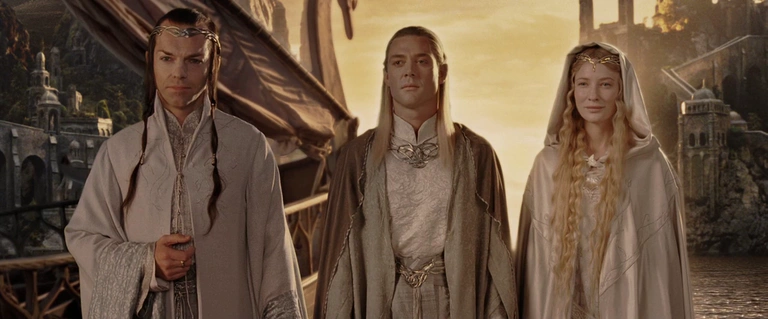
Group
Black Númenóreans
The Black Númenóreans, initially named the King's Party or the King's Men were…
The Black Númenóreans, initially named the King's Party or the King's Men were a fallen group of Númenóreans descended from those who were loyal to the Númenórean Sceptre, but in opposition to the Valar and relations with the Elves. After Sauron was brought as a captive to Númenor in fair form, these Númenóreans listened to his words, and were soon corrupted by him. They worshiped the Darkness, the Dark Lords, and oppressed the Men left in Middle-earth. Ever since, they were the servants of the Enemy and bitter adversaries of the Dúnedain (most prominently towards the Dúnedain of Gondor) who were predominantly descendants of the Faithful.
Second Age
Origins
As the power and knowledge of the Númenóreans grew throughout the course of the Second Age, they became increasingly preoccupied with the limits placed on their contentment in the world - and eventually their power - by mortality, the purpose of which they began to question.
As time went on they began to fear Death more and more and ultimately wished to escape it. So the Númenóreans became envious of the immortal Elves (the Eldar), whom they had come to physically resemble as part of their reward from Ilúvatar for having been their allies. The Eldar sought ever to remind the Men of Númenor however, that death was a gift from Ilúvatar to all Men, and to lose faith in Ilúvatar would be heretical.

Nevertheless, after SA 2221, when Tar-Ancalimon became King of Númenor the majority began to break from the ways of their forefathers, forsaking the reverence of Eru and the Valar. These 'King's Men' therefore were already predisposed to the corruption of Sauron when he came to Númenor.
Eventually, in Númenor's last years, its hugely powerful but elderly King Ar-Pharazôn, who had become "frightened of old age", was persuaded by Sauron that Ilúvatar was a lie invented by the Valar, and seduced him into worship of Morgoth. Within Númenor, the majority immediately followed suit, and this worship quickly passed across the ocean to most of Númenor's colonies in Middle-earth where the group started in proper.
The group thrived in Middle-earth, particularly in Umbar after the destruction of Númenor. They continued to oppose the Faithful, from which came the Kings of Arnor and Gondor. The King's Party remained loyal to Sauron and their lifespans began to wane even before the Downfall. After this time they became known as the Black Númenóreans.
Three of the nine Ringwraiths, who could be considered among the first and most powerful Black Númenóreans, were corrupted by Sauron, 1000 years before the Downfall. They served Sauron, being enslaved to his will, having become so because of their lust for power or knowledge.
These sacrilegious 'black arts' and 'follies', which arose as a consequence of their worship of the 'Dark' and Melkor, marked the final, irrevocable division between the 'King's Party' and the minority known as the 'Faithful' Númenóreans, or the 'Elendili', who kept to their old faith in Ilúvatar. They were also presumably the earliest cultural traits of those who became known afterwards as Black Númenóreans.
After the Fall of Númenor

For many centuries after the Downfall, the descendants of the 'King's Men' held onto colonies in Middle-earth, what became the most northerly and famous of their settlements in exile, Umbar.
Most of those few Númenóreans who had never disavowed the Eldar, and had always remained true to their belief in Ilúvatar, also survived the destruction of their homeland, and they established their own Realms in Exile north of Umbar. The Faithful Númenóreans saw their southern counterparts as renegades and as being responsible for the Downfall of Númenor. The Black Númenóreans held a similarly low opinion of the 'Faithful' and their descendants.
Only two Black Númenórean lords are named from the time of the late Second Age: Herumor and Fuinur. Like all Black Númenóreans and 'King's Men' before them, Herumor and Fuinur desired power over men of other, lesser races, and they "rose to (great) power amongst the Haradrim," the peoples neighbouring Umbar. Their fate is unknown, but they were likely defeated along with Sauron in the War of the Last Alliance.
Third Age
The triumph of the Last Alliance of Elves and Men and the subsequent growth in the power of Gondor marked the decline of the Black Númenórean race and the end of their racial superiority. Nevertheless, the Black Númenórean elite survived at least in Umbar for over a thousand years after Númenor's fall, maintaining much influence in Harad.
The Black Númenóreans are absent from recorded history after their defeat by Hyarmendacil I of Gondor in TA 1050, which broke their power for good, but a population of sorts evidently lived into the latter part of the Third Age. Queen Berúthiel, wife of Gondor's King Tarannon Falastur was a Black Númenórean, from a realm somewhere south of Gondor. Her marriage was a loveless union, and was presumably a political accommodation. Additionally, the Mouth of Sauron, who mocked the army of the west in front of the Black Gate was described both as a Black Númenórean and a "Renegade".
The Return of the King (1980 animated film)
In The Return of the King (1980), a leader of a Black Númenórean battalion is seen briefly yelling at a group of Orcs. He is voiced by Don Messick.
Games Workshop figures
In one of his letters, J.R.R. Tolkien stated that three of the Nazgûl were Númenórean; in the non-canon Games Workshop models only two of the Nazgûl are identified as Númenórean: The Dark Marshal - The most black-hearted and unrelentingly cruel of all the Nazgûl, his name is a byword for misery and death. Where the Dark Marshal passes, evil creatures fight harder, fearful of their lives whilst good warriors feel the icy touch of death upon their hearts. By his armour it is guessed that he is one of the three Númenórean Ringwraiths (the best match for this particular Nazgûl is Herumor or Fuinur) and The Knight of Umbar - The third of the Númenórean Lords to become one of Sauron's servants, the Knight of Umbar's past is shrouded in mystery. If the rumours pertaining to him hold any truth, he was once one of the great Númenórean kings who ruled the Southlands prior to the days of the Last Alliance. (the best match for this particular Nazgûl is also Herumor or Fuinur who came from Númenor island to the south during the second age, even though either one or both of them became the Lords of Haradrim. It is also known that both Haradrim and Umbar were in league to destroy Gondor).
Sources
Adapted from the original article, under CC BY-SA 3.0.