Lore
Old Entish
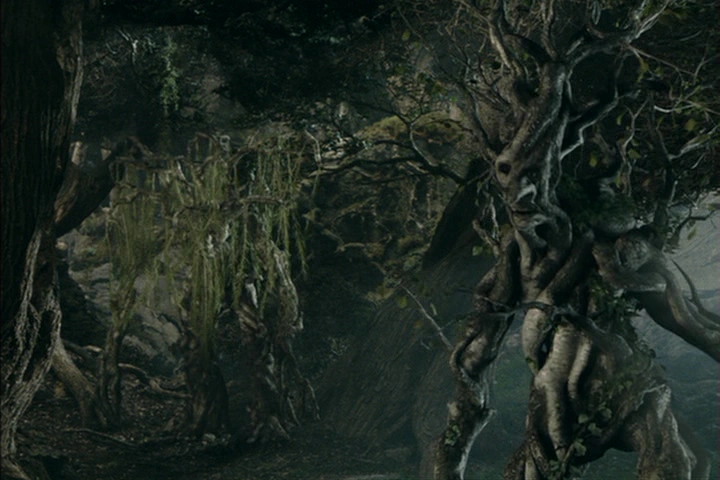
Old Entish, or simply Entish, was the ancient and rumbling language of the…

Real names tell you the story of the things they belong to in my language, in the Old Entish as you might say. It is a lovely language, but it takes a very long time to say anything in it, because we do not say anything in it, unless it is worth taking a long time to say, and to listen to.
Old Entish, or simply Entish, was the ancient and rumbling language of the Ents, a race of tree-like beings created by the Vala Yavanna. Their language appears to be based on an ancient form of Common Eldarin, later enriched by Quenya and Sindarin, although it includes many unique additions.
History
After meeting the Eldar sometime during the Elder Days, the Ents developed the desire for a spoken language. The language that resulted from this desire was unlike any other language of Middle-earth, as it was described as being "slow, sonorous, agglomerated, repetitive", and very long-winded. Only Ents spoke Old Entish; not because they kept their language a secret, as the Dwarves did with Khuzdûl, but because no other could master it, as "even the lore-masters of the Eldar" made no attempt to record it in writing due to its complex sound structure. Contrary to the Elves, the Ents found Quenya to be a lovely language and adapted it after "Ent-fashion" to everyday use, along with its vocabulary to the Entish grammatical structure.
The Huorns and trees of Fangorn Forest could understand Old Entish and converse with the Ents and each other with it. The grammar structure of Old Entish was also quite bizarre, often described as a lengthy, long-winded discussion of a topic. There may not even have been a word for yes and no: such questions would be answered by a long monologue on why the Ent in question did or did not agree with the Ent who asked the question. Ents as a rule would say nothing in Old Entish unless it was worth taking a long time to say.
Words and translations
Most of the Entish words and vowels are almost entirely based on Quenya and Sindarin, the two most common languages spoken by the Elves.
a-lalla-lalla-rumba-kamanda-lind-or-burúmë or a-lalla-lalla-rumba-kamanda-lindor-burúme - "the only extant" fragment of a part of the word for "rockshelf" or the name of a specific hill was described as a "probably very inaccurate" partial sampling.
Taurelilómëa-tumbalemorna Tumbaletaurëa Lómëanor - Quenya in "Ent-fashion" meaning literally "Forestmanyshadowed-deepvalleyblack Deepvalleyforested Gloomyland" or as Treebeard put it: "there is a black shadow in the deep dales of the forest".
Treebeard once described Orcs as "evileyed-blackhanded-bowlegged-flinthearted-clawfingered-foulbellied-bloodthirsty", adding morimaite-sincahonda ("blackhanded" and "flinthearted") in Quenya.
burárum - "Entish noise of disgust" directed mainly towards Orcs. It is possible that burárum "may be a fragment of the Entish word for" Orcs.
rárum - "wanton hewing" or "orc-work" is the most likely meaning.
Wellinghall - A partial Westron translation of part of the Old Entish name of Treebeard's dwelling, though the original name is untold.
ra-hoom-rah! - "a great ringing shout" that began an unnamed marching song the Ents sang as they marched off to assault Isengard.
Sources
Adapted from the original article, under CC BY-SA 3.0.