Lore
Hobbit-hole
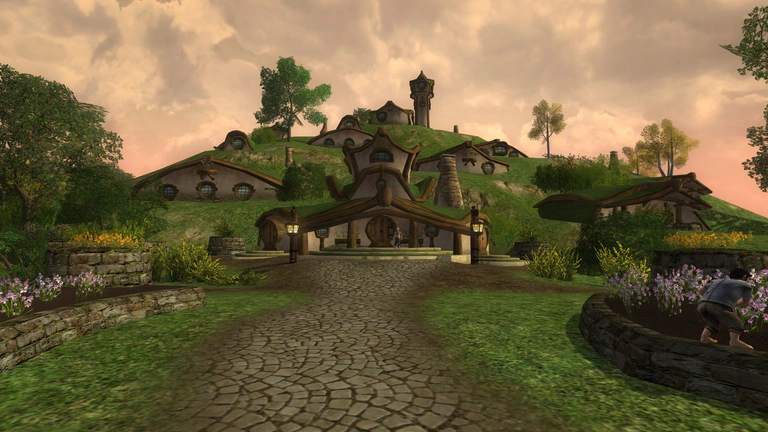
Hobbit-holes, otherwise called Smials, were the preferred dwellings of Hobbits…
In a hole in the ground there lived a hobbit. Not a nasty, dirty, wet hole, filled with the ends of worms and an oozy smell, nor yet a dry, bare, sandy hole with nothing in it to sit down on or to eat: it was a hobbit-hole and that meant comfort.
Hobbit-holes, otherwise called Smials, were the preferred dwellings of Hobbits in the Shire.
History
They were holes dug into hillsides, banks, earth mounds or downs, and usually had a minimum of one round window, a front door, and sometimes a back door. It was primarily the wealthy Hobbit families that built spacious and luxurious versions of a Hobbit-hole. Brandy Hall was an example of a deeply delved Smial, having three front doors, many side-doors, and around one-hundred windows. Bag End, the home of Bilbo Baggins and later the Sackville-Bagginses, and then Sam Gamgee, can be considered a large and ramifying Smial. It was an expansive Hobbit-hole with many windows; a large circular green front and back door, and an ample number of rooms; as well as the famously renowned pantries which supplied food for many a party or celebration.
On the other hand, the poor lived in old burrows or primitive diggings, with perhaps only a single window. An example of this was Bagshot Row. The famous Took family lived in the Great Smials, their ancestral home, a many-tunneled mansion suitable for a hundred Hobbits.
During the Scouring of the Shire, many Hobbit-holes were destroyed and replaced with wooden shacks.
Sources
Adapted from the original article, under CC BY-SA 3.0.