Place
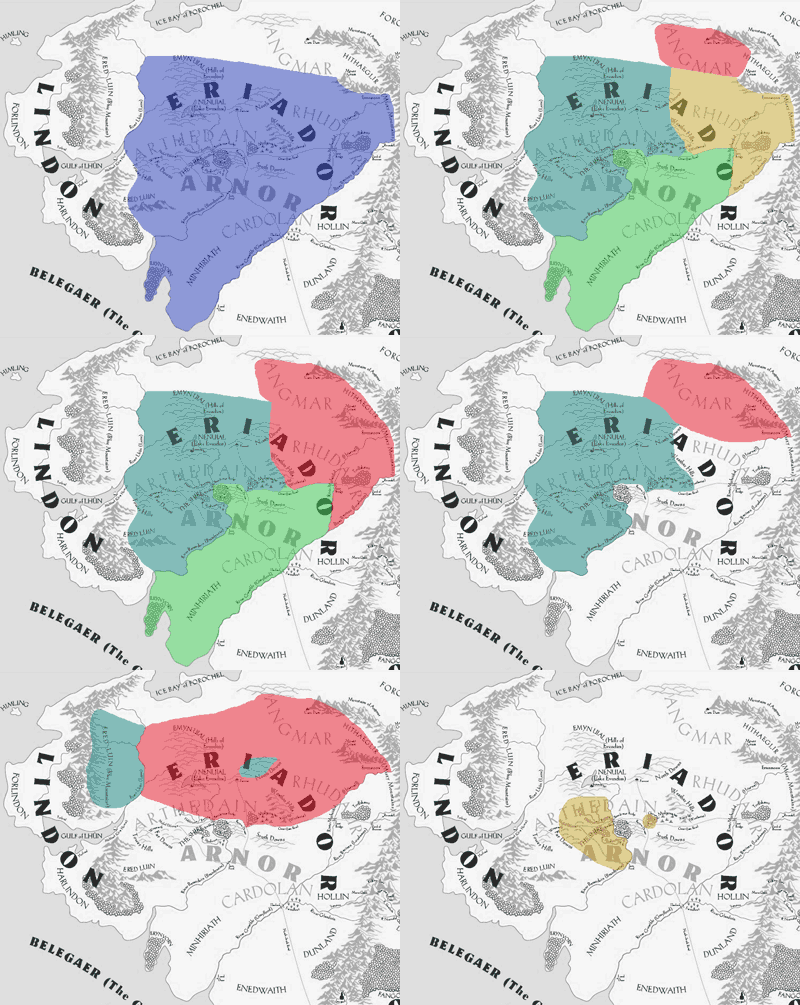
Enedwaith
Region of Middle-earth between Arnor and Gondor
Enedwaith was a region of Middle-earth between Arnor and Gondor. The word also referred to the men who resided there, sometimes called Haladin.
History & inhabitants
During the First and early Second Ages, Enedwaith was heavily forested; however, with the arrival of the Númenóreans from the west, the landscape was deforested from the seventh century of the Second Age onward.

The peoples of Enedwaith were distantly related to the Haladin of old (the Second House of the Edain). However, this fact was not recognized in time by the Númenóreans (who were mainly descended from the First and Third Houses of the Edain) and thus spoke a language that was not related. It is mentioned as well that the Dunlendings of Calenardhon were not ranked as Middle Men, but instead ranked among the "people of darkness," enemies, and aliens.
The forests of Enedwaith (and much of those to the north in Eriador) were conclusively destroyed by the War of the Elves and Sauron around the year SA 1700, during which much of what had survived the felling was burnt. Only isolated corners like Eryn Vorn and the Old Forest survived. Many surviving natives took refuge in the eastern highlands of Enedwaith, "the foothills of the Misty Mountains," which ultimately became Dunland.
After SA 3320, Enedwaith formed the most western part of the new Kingdom of Gondor. The south-west still had some scattered woods, but elsewhere Enedwaith was by this time primarily grasslands. The only known settlement was at Tharbad, maintained jointly by Gondor and Arnor (later Cardolan), to protect the city and the North-South Road. Nonetheless, following the Great Plague of TA 1636, Gondor's authority permanently ended throughout the region.

Tharbad (initially one of two ancient cities on the Gwathló and the only one to survive beyond the early Third Age) was finally abandoned following devastating floods in TA 2912. After that, only Dunland remained inhabited.
However, in the early Fourth Age, Enedwaith was absorbed into the Reunited Kingdom.
Sources
Adapted from the original article, under CC BY-SA 3.0.